The Attention Game

The art form of improvised performance can sometimes feel like walking a tightrope between seeing and being seen, hearing and being heard, getting attention and giving attention. When I get out of balance I start to wobble. I start to shake. Sometimes I fall.

I get this wobble sometimes when I’ve done a well-received thing. I exhale. Can I rest now? I’ve proved my worth, demonstrated my mustard, exhibited my toucan. The job is done.

I even experienced it with this blog. Lots of lovely people gave me positive feedback and I thought, Huzzah! I can do it. I’ve got something to say and people are listening. How amazing! I wasn’t expecting that. And then I froze up and thought, what the earth am I going to say next?

…Oh my goodness; I have to keep going! But how?

A while back, in a showcase, I even got out of balance mid-improv. It was a tag-out song and as soon as I was tagged out, I stood on the side watching the play. I’d set up something fun for my teammates. I then found myself resolving, ‘Well, that’s that sorted,’ and settling onto my back foot, metaphorically dusting my hands off and resting on my laurels.

I learned the tag-out song technique in a class on Game of the Song from Heather Urquhart and Joe Samuel. In the exercise, two people start on stage. They begin the scene. In the wings waiting are the rest of the team. When a player-in-waiting notices something interesting, they run in, tag someone out, slot themselves in as the same character and heighten that thing.

It’s fast. It’s frenzied. It’s very fun.

While leaning into my back foot I watched the action fly. I knew there was a beat I should have taken. I felt it open up. It was my moment to head in again but I found my feet didn’t move. I was resting against the wall.

What was I doing this for? I was missing out. I was denying myself the fun of getting in there because I didn’t want to mess up having made a half-decent start; I was worrying more about how I was being received than where the fun was at.

When the next opportune moment rolled around I couldn’t let it pass me by again so I pushed my feet forward.

Was what I did any good? I’ve really no idea. Had I been giving my full attention or worrying about messing up? I’d been worrying about messing up.

A tag-out song should be a brilliant exercise in giving attention. It dawned on me, I was prioritising the attention I was receiving as opposed to the attention I was giving. And that doesn’t make for maximising fun times.

Afterward, people in the audience said our tag song did look super fun. One person even said they’d decided to try musical improv now from watching how fun we made it look. This meant a lot to me – yum, validation. I was part of a team but only I knew the secret that I’d held myself back and this made me feel like a fraud.

“When we keep trying to get attention and that gets out of balance we cut off our own oxygen supply inwardly.”

Mark Nepo

Mark Nepo talks about the difference between getting attention and giving attention on Elizabeth Gilbert’s podcast – Magic Lessons. He gives advice to a poet who has failed to get onto an MFA program and is wondering whether to give up entirely on this thing she loves doing. Nepo says that it is the giving of our attention that must drive us. He suggests that instead of asking from where we are getting attention, we need to instead ask: what am I giving attention to?

As well as exploring our motives behind why we improvise, I think this question can be a beautiful one for scene work. In an improv scene, it can be really easy to get caught up in worrying about what you are bringing, what you are doing, and for what you are getting noticed. But if we flip it and look instead at what we are giving attention to, we can serve the scene better. If we ask what is my character noticing? What are they looking at? What do they care about in relation to what is coming up? If we focus instead on where we are giving attention we can create something deeper. What are we noticing about what our scene partner is doing? What subtleties are we picking up on? What is the sub-text? What is going unsaid?

What are we giving our attention to? And why does it matter to us?

Joseph Gordon-Levitt gave a TED talk where he spoke about how craving attention stifles his creativity. He explores how when he is acting he is totally focused on the scene. He recognises this is needed for his craft. He has also noticed that through many repetitions he’s developed a pattern that enhances his skill. When action is called, he enters a trance-like state of creative flow. I think many improvisers can probably identify with this. I experienced it recently in a show. It felt like my creative brain took over and left me for dust. Afterward, my memory of the show was a blur. What I could remember was in a jumbled order. It was like a montage of snapshots in my head. The area of the brain forming long-term memories was probably taking a back seat.

The show went extremely well but beforehand I’d been apprehensive. It was a new show and we hadn’t improvised in front of a live audience for a long time due to the pandemic. I had no idea by that point whether we would be funny or interesting to real people sitting out there in rows waiting to be entertained. Because of my fear of not being funny enough – about what attention I might get on stage – I found myself hoping the other acts might be a bit less funny. I really liked the other people. I wanted them to succeed but I also had a voice in me that was there because I was performing later, and I didn’t want the competition to be too high in case I didn’t do a ‘good improv’. I wanted others to succeed as long as I did. And we don’t get to make that deal in improv. Or in life.

Joseph Gordon-Levitt also talks about how if he looks at his fellow actors as his competition for attention he misses out on ways to collaborate. Sometimes we see improvisers getting on stage with a competitive vibe. They’re looking for ways to ‘win’ at improv. Sometimes we are those improvisers. If I walk into a scene with the aim of ‘winning’ at improv at the expense of a scene partner, I know something isn’t right. I have to give some attention to why that is happening and what to do about it. The competitive voice is not the voice I want to listen to. I want to be thinking: who here do I want to give attention to? Who here do I want to create with?

I was working with a group where I never really got the feeling I was doing anything half-decent. I kept trying. I’d bring in exercises I’d learned in classes or that had brought me tremendous joy with other people. They didn’t zing. I couldn’t work out what I was doing wrong. I kept trying. I then was prompted by a friend to think less about whether or not that group thought I was any good but whether I was enjoying the improv. I realised I wasn’t. I realised whenever the opportunity to work with the group came around I wanted to find an excuse. I rarely ever feel this reluctance to improvise. It made me realise I’d been so focused on what they thought of my improv, I had neglected to notice what I felt about theirs. I realised I didn’t fit in with the style the group was aiming for and I needed to opt-out of working with them.

Giving my attention to what was really going on allowed me to see what I needed to do clearly. This was compounded to me in a scene where I felt disconnected but was getting lots of laughs. My scene partner was playing an authoritarian character and was closed off emotionally. Despite the laughs I was getting, my character suddenly said, “I just want to go home.” This is what we refer to sometimes as ‘the improviser talking‘ as opposed to the character. I know I can get laughs from riding tension but the attention I was receiving from the on-lookers wasn’t enough in this instance to mask how I felt. I knew something wasn’t working.

It is fun sometimes to get attention for being a bold character or a show-off but I want to give my attention to the emotional core of a scene and to do that I have to connect. I can make people laugh; I can get attention, but making the audience feel something for my characters is important to me. I feel I owe my characters that much. I’m giving them a moment in the spotlight. The least I can do is make it matter. The least I can do is give attention to my characters.

That may seem a somewhat abstract premise. However, if you think of your characters as real people, it may make more sense. I was once endowed with being a pompous bishop in an improvised Dickens show. It threw me because Dickens doesn’t write a lot about religion so I got stuck in my head thinking the audience would think it inauthentic. I was aware people were finding my character funny but I hated the character and refused to give him my attention. In the middle of the show, I had to deliver a kind of mantra for the character. I had no real idea about what the bishop’s voice even sounded like by that point so I opened my mouth and a completely different voice popped out. I felt really stupid – what must the audience have thought? I was so embarrassed I disconnected from the character entirely, refusing to bring him back on stage again. I was much more caught up in worrying about the attention I was getting, than giving my attention to the core of the character and his interactions with my fellow players. I could have found his humanity if I’d just been looking for it but I was focusing elsewhere. I was focusing on myself. And metaphorically, I wasn’t even there!

We are living in a world where we are increasingly encouraged to focus on the attention we are (or aren’t) getting and to feel shame surrounding that. Shame sells. As Joseph Gordon-Levitt discusses in his talk for TED, social media is training its users to crave getting attention. Attention is their commodity. They have to train their users to want it and to give it freely and, of course, in ever-increasing quantities. Most of us use social media. Most of us are part of this trade. This can worm its way into our psyches even away from the screen. We are being trained to need attention but do we ever feel truly seen?

If we go through life focused on where we are getting attention we can veer off our track. We can get caught up chasing the things that do not interest us, the things we do not love: the people, the jobs, the careers, the hobbies, the communities. We can end up being bounced about by what drives others, without stopping to ask: what drives me? About what am I passionate? To what do I most want to give my attention?

What I’ve come to realise is that when I give attention without getting anything back, I become resentful. But when I get it and do not give, I feel a fraud. At the very least I miss things. At the worst it can kill my creativity.

It’s easy to think when you do something half-decent, you don’t have to step forward again. It’s easy to think if you’re not receiving attention for something you love doing, it is time to give up. But to balance on the tightrope, we need to honour what we are choosing to give our attention to. So if you are resting with your back against the wall, try asking not what attention you are getting; ask instead what you are giving your attention to. That’s where your real-life lies. Regardless of whether anyone is watching.

…So get back in there and give it all you got!

10 Ways to be More Tree in Improv

When was the last time you sat with a tree? Maybe it was yesterday, maybe last week. Maybe it was last month or year. Time spent with trees is good for our health.

I went for a walk with my friend and her tiny son the other day and while we were walking through a copse, he quite suddenly ran up to one of the trees and hugged it. To my jaded adult eyes, I didn’t see much to single this tree out from the rest of them, but nevertheless, I joined him. I figured the tiny human probably knew the tree needed a hug. Or maybe I misunderstood, and it was instead the need of the tiny human being satisfied. The bark was comforting to hold onto. We were clinging to life-saving stability in a chaotic world.

I sometimes get a stress response I call ‘being a bucket of bees’. When I feel those fuzzy fellas buzzing throughout my body, I know it’s time to head to the woods. The magnitude of trees helps my challenges feel little, like a speck in a wide, wild world. The age of trees reminds me not to hold on too long to that which no longer serves me.

“Don’t sweat the small stuff,” the trees say to me and if I make the time to stop and listen, the slow stable satisfying energy of the woods drives the bees right out of me.

Forest bathing, or shinrin-yoku, is a term that was coined in Japan in the 1980s. It was created to champion the effects of time spent with trees on human health in response to the rising cases of tech burnout. It also had designs for protecting the country’s forests.

The human eye can perceive more shades of green than any other colour due to having adapted over the many, many years we lived in lush forests and jungles. There was an evolutionary benefit to being able to detect different greens when foraging and also in avoiding becoming prey. For me, time spent amongst trees feels like coming home, and our evolutionary story could well explain that sensation.

As part of our Beltane improv celebrations this year, I played a ‘mother tree’ in the forest, quite happy with their lot. Playing plant life is one of my favourite things to do in improv. I’ve certainly played a few out-of-control plants in my time, including triffids and Little Shop of Horrors style horticulture. Rampaging foliage can be very fun but recently I’ve found my portrayals of plant life want to be more peaceful. The wisdom I feel oozing from the green world is wide and broad and stable.

There’s a lot we can learn from trees. Generally, trees like to be around other trees. Trees like company. Some trees manage with solitude but most species of tree, don’t generally do so well single. Trees on their own are more likely to get sick. They are more susceptible to insect attacks because they haven’t got other trees around them to warn them of danger. They need a network.

One of my favourite group warm-up games is ‘I Am Tree’. Players get to make connections, support each other, build on each other’s ideas and stand tall together. It feels tree-like to me.

And the game starts with a tree.

One person enters the centre of the circle and proudly exclaims, “I am tree.” Another steps forward, “I am branch.” Another, “I am bark.” The ‘tree’ chooses which of the two associations will lead the next round. “I choose bark.”

Bark then repeats, “I am bark.” And we begin again: “I am squeak.”, “I am chirp.”

See what they did there? “I choose squeak.”

“I am squeak” …And so on.

This could be a great warm-up to kick off your tree-inspired improv practice.

There’s a lot more to trees than meets the eye. People have known trees are amazing for a long time but the ‘modern world’ decided at some point it had trees figured out and so started to cultivate them for economic gain. The ‘modern world’ started creating forests that were by design and tended to include only one type of tree, sometimes two. Trees don’t like that. But we didn’t stop to notice because the modern world can be like that.

The modern world people thought trees must want to grow fast because the modern world people want everything quickly. Surely trees must feel the same?

They do not.

Trees like to grow slowly. They like to be around lots of different trees. They like to feed each other, and they particularly look out for their kin. Trees know their own saplings. To use our human words: trees have families. They have friendships too. They support each other. They’re connected.

“In mature forests, trees and plants communicate and interact with each other through vast underground web of fungi which connect the trees and plants. Resources are shared through this network – carbon, water and nutrients – so helping the whole system of trees and plants to flourish.”

Sharon Blackie, If Woman Rose Rooted

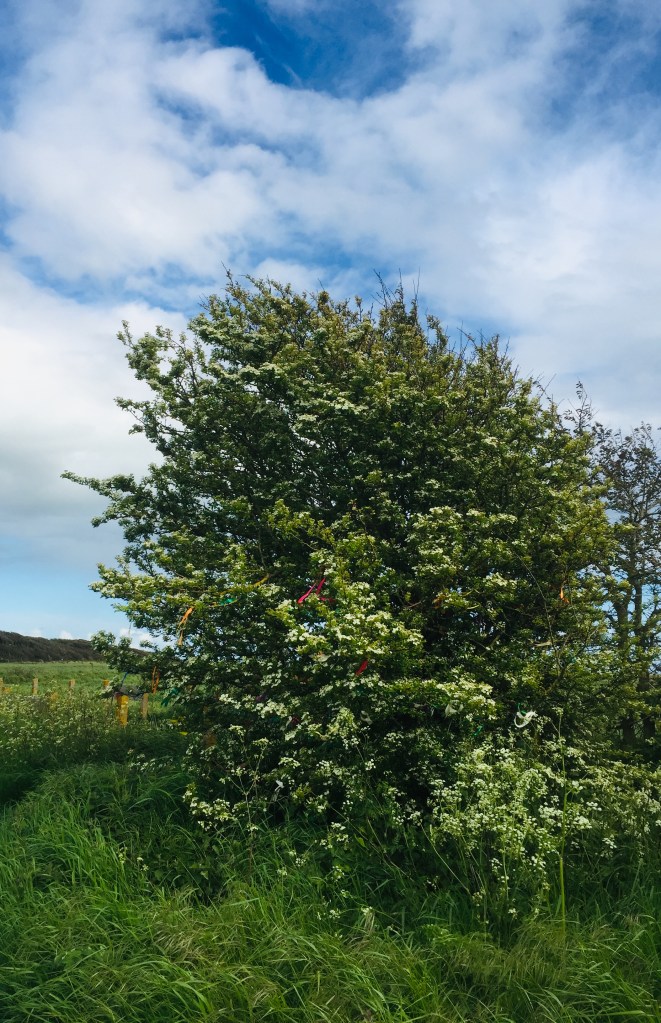
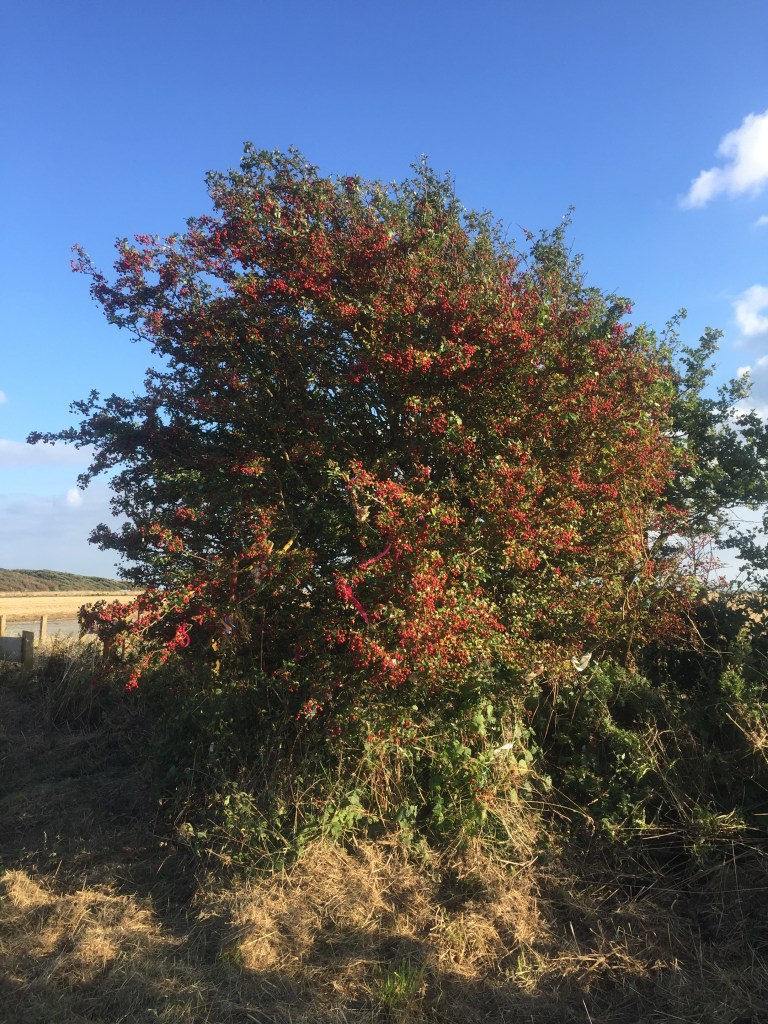
I’ve been trying to get to know a tree. I had been, for a long while, walking or jogging around this hawthorn in a radius which felt good to me. Without knowing what I was doing, I made this tree my touch tree and since recognizing this I’ve been consciously returning to meet regularly with this tree.

Hawthorn in Summer

If you’re lost in the woods, it’s recommended you identify a touch tree. This is a tree that stands out from the rest, preferably taller. As you explore your surroundings and carry out your survival, you can keep coming back to touch this particular tree, so you don’t stray too far from your original location. Straying too far is how people can get lost for good. A touch tree can help you get found.

And so it is that this beautiful Hawthorn has become my touch tree. Whenever I feel lost in a metaphorical wood, I visit this beautiful living being who helps me remember how to feel grounded.

The more I’ve visited the tree, the more I’ve become painfully aware that I don’t have the right words for engagement. This tree is not an ‘it’.

Living. Breathing. Surviving, striving and thriving. Alive.

Not an ‘it’.

But what other words do I have?

I tried out ‘He’ but that didn’t feel right at all.

I gave Hawthorn a name. Hawthorn.

It seemed the best I could do. But I was so aware it was my name based on human identification. How do we engage with nature when all our words for ‘it’ set us apart, separate us and give us ownership we just should not have? Don’t have. But often assume.

Hawthorn in Autumn

Words woefully failed me. So much language surrounding nature is presumptuous and reductive. This tree is my equivalent. Another life. And I have no doubt, that Hawthorn is much wiser than I. Hawthorn knows how to be a tree. Better, I am quite sure, than I know how to be a human.

So how can we lessen this divide? How can we learn from the green world? How can we be more tree?

What might a tree tell us about how to improvise? Here are 10 ways to be more tree in your improv:

  1. Play plant life – I’ve been lucky enough to play a fair few triffids in improv. I think I watched that film wanting the triffids to win, to be honest. But plant life doesn’t have to be vengeful to be interesting. Try playing the spirit of an old oak tree, a pungent spruce or a resourceful elm.
  2. Slow down – practice growing slow and steady with some slow burn improv. One of my favourite exercises in this is to agree to no speaking for the first minute of a scene. Experiment with what happens during this minute. What emotions arise? Can you sense how your character feels about the other character/s? You may even decide to do a whole scene without words.
  3. Get connected by establishing your own network of giving and receiving gifts – The more connected you are with a fellow improviser, the more in tune you are. This means you will become more aware of subtleties that alert you to what’s going on between characters on stage. Body language, tone of voice, a flicker in the eyes; this is how we awe the audience with our unscripted performance by getting ahead of them.
  4. Make space – Some species of tree do an amazing thing called crown shyness. If you look up at a canopy, you may see that trees have grown in such a way whereby the tops of them leave space for their neighbouring trees. Think open umbrellas in a crowd where no two umbrellas are touching. Practice crown shyness in improv by making space for your scene partner to grow. If you find yourself without much space, use what you have purposefully. I did a scene recently where my scene partner was talking a mile a minute. There was hardly any space for my character, so I decided to deliberately pair back my speech to very little. It made my character really sinister, as my long silences heightened the tension.
  5. Get grounded – trees are of course great at digging deep. A strong and stable root system makes all the difference. Getting grounded in a scene might be as simple as planting your feet to avoid what I’ve heard referred to as the improviser’s shuffle. Another thing to get grounded is to give yourself some object work to do. It can really help locate you in the world you are inhabiting. If, like my brain, yours also worries about doing too many things at once, make the action simple. See if you can find something repetitive. You may even find it soothing. In rehearsal, we sometimes play a scene doing object work with our eyes closed. We don’t say what the object work is prior to the scene, it’s like our little secret, as only those watching can see what both people are doing. This is something we learned from Jonathan Pitts in his exceptionally brilliant workshop on strength in vulnerability.
  6. All together – do some group scenes where you all make an effort to nurture each other with endowments and gifts. What can you tell each other about your characters? What can you build when you are all giving? Try out scenarios like being in a press-gang or at the AGM for an unusual interest group.
  7. Feed your improv family – it can be really easy to get caught up in promoting your own shows and troupes, but don’t forget to support others in your community. You might feel someone else is just a sapling, but saplings can grow really quickly under the right conditions. Today’s sapling is tomorrow’s mighty oak. So support your local community. Trees send nutrients to saplings, veterans, and even to fallen trees and stumps. Let’s all help each other to grow taller.
  8. Embrace diversity – trees love to be around different types of trees. The healthiest forests are varied and rich with many species. Everyone has something to bring to the mix. Diversity shouldn’t be a tick-box exercise. It’s an opportunity. The more perspectives you have, the broader your storytelling can become. And you will likely appeal to a wider audience.
  9. Find a ‘touch tree’ – Identify something in a scene you can return to when you start to get lost. For me, this is often how my character feels about the character/s they are with. If I can get back to how they feel about someone else and why it matters, I can usually find a way through even the densest of scenes.
  10. Give yourself time – it can be so tempting to rush. But a lesser-known secret in performance is the audience will wait. I particularly find myself rushing in musical improv. The more I practice, the more I realise there is time. Pause. Breathe. In. Out. Follow your breath into your words. Make. Every. Word. Count. For a super exercise in this, try ‘Seven Words or Fewer’ which I learned from Chris Mead. Limit each line per person to no more than seven words. It gives you the time to play with pauses and is a great discipline for making every contribution count.

I once attended an interactive session at The Old Market in Brighton. It was all themed around woodland and as part of the activities, you got to experience, through virtual reality, moving along the sustaining systems of a tree. Shooting up through the tree as rainwater was such an extraordinary experience. Its impact was immense. I still remember vividly how it felt.

We also got the opportunity to sense the world as a frog and a bird. As a frog, I managed to get stuck somehow but due to being unable to get my virtual frog legs to move, I spent the time looking around at how the frog sensed the world, and how it perceived vibrations. Frogs have always made me feel uneasy but this experience enabled me to understand how a frog must see me. It gave me that chance to see the world with new senses. Frogs have unsettled me much less since because I understand them better.

Perceiving through a fresh perspective has the profound power to create empathy and compassion, not just for the members of our own species but for other species too. Playing a range of life through improv can encourage us to understand how other life lives. It can prompt us to care more for the other living things around us.

This time of year is perfect for being more tree in your improv, for reviving interest in trees and for celebrating plant life. Earth Day, Beltane, and the move from spring to summer are all upon us again. Blossom is about, bluebells are blanketing woodlands and the many shades of green are out in full force here in England.

This post contains images of some of my favourite trees. Consider finding some favourite trees of your own and sitting with them. Listen and learn. Connect. I’m in a group where we share our encounters with trees and plant life. When one person shares, it reminds others to do so too. We have created a feed of pics documenting personal encounters with nature. We do this together, which brings me much joy.

I’d recommend finding and feeding your community. It’s encouraging to know you’re not alone in your loves.

We are also not alone in life. Life is everywhere. Try playing it all and see what blossoms.

The Lightning Tree at Patching

11 Ways to Own Your Own Scene

Do you ever get an offer and just think, my goodness, what the earth do I do with this? I was recently endowed as a prostitute. It wasn’t what I was expecting. It threw me to be honest. Maybe reading this statement threw you. It’s that moment, isn’t it? The moment when you think: woah, where did that come from? And where the heck is this going?

Regardless of the curve ball, I had already chosen high status for my character so I committed to not dropping my point of view. My scene partner then held me responsible for the losing of his erection. Wow. My boss moves weren’t doing it for him apparently. I was doing improvised prostitution wrong.

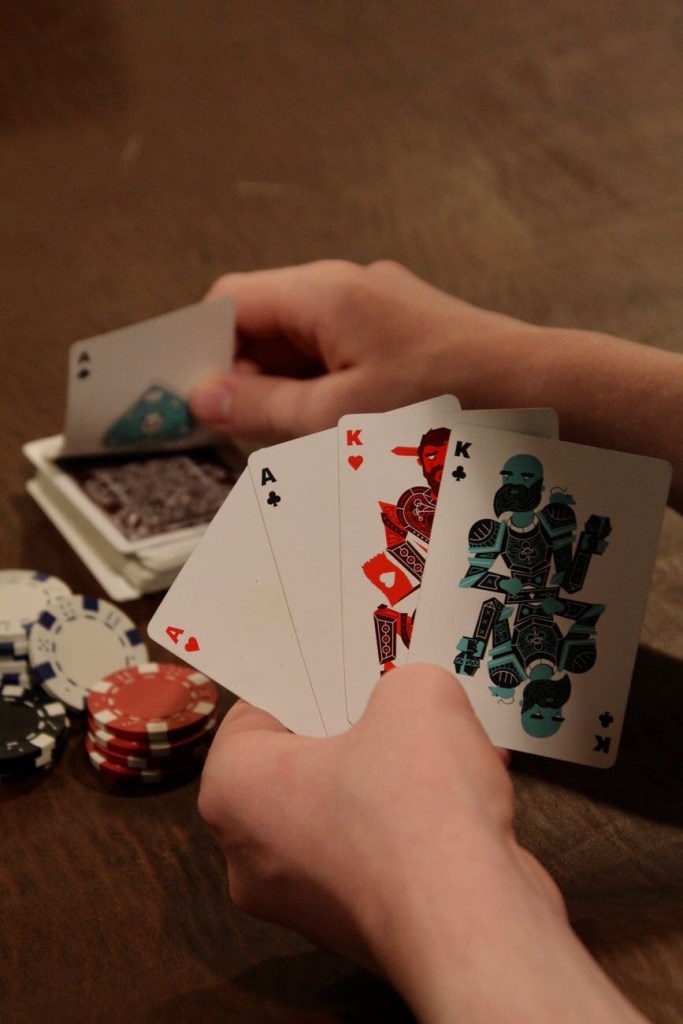
Turning around a scene from within isn’t always easy, especially when your scene partner has an idea where they want things to go. So what options did I have in this situation? Did I have to accept the cards I’d been given?

Not the credit cards, no.

In improv we do, to an extent, have to accept the cards we are dealt. That’s the foundation of our craft. Accepting them is the first step. Once they are in our hands, how we choose to play them is up to us. Although, that doesn’t mean our moves are always going to be well received. Some people don’t like it when you lay a trump card.

I want to think of improv as a collaborative effort. I don’t enjoy it as much when it’s a competitive sport but I acknowledge that everybody gets to choose their own improv style. Accepting others play differently is necessary.

“You don’t have a right to the cards you believe you should have been dealt. You have an obligation to play the hell out of the ones you are holding.”

Cheryl Strayed, Brave Enough

In order to own our own scene, it’s important to know you don’t have to hold to every rule you’ve been told makes ‘good’ improv. You get to decide. You can get up from the game table if compromising improv is all that’s being served.

On this topic, I’d really recommend reading Patti Stiles’ book Improvise Freely. It has helped me feel so much more confident regarding my instincts. Before I started to explore how I could own my own scene, scenes owned me. That put me in a tricky position. A scene partner could decide where a scene went and I had to follow, dutifully. Sometimes with a mop.

I was once, to my detriment, a fully paid-up member of the “Yes, And” club.

I have since revoked my membership.

I did a show recently where my duo partner’s character asked mine to marry him. I knew how my character would answer. I said “No.” The laugh from the audience was so big we cut the scene and moved on. It felt great.

Even if we’d continued with that scene there would have been two strong viewpoints to take forward. This thinking was inspired by Patti Stiles’ advice in an interview she gave for The Art of Yes. A far less progressive answer to the marriage proposal would have been to say “Maybe” and then have to spend the rest of the scene debating the decision. If I’d said “Yes”, perhaps we could have discussed the flower arrangement or where our mothers would sit in the church.

“No.” in this context, felt the more interesting answer.

Afterward, an experienced improviser in the audience came up and commented with surprise, at my lack of “Yes, And.” I explained how “Yes, And” was about accepting an offer. Not actually having to say “Yes, And.”

Holding people to account for not using “Yes, And” literally, doesn’t give them credit for being accountable for their own decisions onstage. If we want improv to move forward into the territory of equality, we have to let go of this firm grip on literal “Yes, And”.

“When I was first starting my improv education in the GTA (Greater Toronto Area), I thought yes meant I had to actually say yes to everyone’s ideas – even if that idea made me uncomforatble. This led to many times where I felt incredibly used and unsafe. I later learned that our role isn’t literally to say yes to everything, it’s just to accept the offer and continue to move forward together.”

Hayley Kellett, Improv & Consent: Why “Yes, And” Doesn’t Always Mean Yes, quoted in Improvise Freely

Floating the ‘rules’ in order to do what works for you, and your character, can feel scary but Stiles demonstrates how the ‘rules’ are made up anyway and don’t work so well when used universally. They won’t make sense in every situation. We can say “No.” We can time out. We can leave the stage.

I was in a class once where my scene partner threw something critical at me about my character’s mother. I rolled over and did a “Yes, And”. Liz Peters (from The Maydays) – who was teaching the class – stopped the scene and asked me, “Is that really what you wanted to say?” “No,” I said a little scared. “Well, say what you want to say. He’s out of order.” Thanks, Liz.

It’s a brave move, to go up against “Yes, And” but it can also be an inspiring one. It can feel like taking on the boy’s club. That’s a big thing to buck against but heck, if we want to own our improv we have to. All of us. Every one.

“Simplistic rules reduce awareness and replace it with conditioned behaviour. When we condition improvisers, we replace possibility and perception with predictive responses. This leaves improvisors vulnerable to others who are using this rigid rule to control and manipulate scenes. Empower improvisers to question, to be free thinkers. Give them the tools – not rules.”

Patti Styles, Improvise Freely

Here are 10 potential tools to explore in your improv to take responsibility for your improv and also yourself. We can sit in a space of feeling offended by someone else’s offers or we can do something about them so let’s see what we can do to take back our power.

  1. Look out for yourself before your scene: – We can get taught the scene is sacrosanct. It is not. It is just an improv scene. You are far more important. Do what you need to do to take responsibility for your emotional landscape even if that means disappointing others. No one else is going to know what’s going on for you fully so you have to put yourself before the scene. We need to take responsibility for ourselves because we all have different limits.
  2. Know your boundaries: – Explore your edges so you can be clear about what lines are important to draw in order for you to not betray yourself. If you are new to thinking about boundaries, start by noticing how your body feels. If you start to feel icky during a scene you might be coming up against a boundary. Consider what boundaries you need to have in place to honour your time, your energy and your emotional well-being. Once you recognise where your own boundaries are, then follows the need to communicate them clearly to others.
  3. Have the hard conversations: – If you’ve reached your limit, it might well be the time to reach out and have a hard conversation about that. Sometimes hard conversations can reveal to you that you are not the only one who feels a certain way, that you are not alone and that other people are falling over themselves to improve a situation. Sometimes, however, you discover that there are some people who don’t want to have hard conversations. Both ways you learn and you can choose the people you want to stick around. Recently some of the guys I improvise with have been asking how I felt about the status choices they made in scenes. I love this! It opens up a conversation where we can discuss together what character dynamics feel appropriate to put in front of an audience. We can also establish together our collective limits.
  4. Accept the reality but pick your offers: – Offers can take on multiple forms. They might be physical, environmental, emotional, verbal or status related. You don’t have to respond to every part of an offer to move things forward. You can accept the reality the offer has created but only take part of the offer forward. Patti Stiles in her book Improvise Freely describes a time she accepted a sleazy line but focused on the accompanying gesture and what else it might mean. She effectively turned a lewd crotch scratch into grounds for a divorce. If you want to know just how she made that happen, I recommend you read her book.
  5. Boss your character: – No one knows your character as well as you do. You know what they think and feel. You know what they want to say. You also know what will change them. By giving your character license to behave the way they need to you can practice giving yourself the same license. I once had someone come up and tell me what I ‘should’ have done in a scene that had been highly praised by a teacher. I dutifully thanked this guy but I told him my character wouldn’t have done what he suggested as it wasn’t in her motivation. The guy looked like I’d slapped him in the face. This is your permission to own your creation, own your character, own your improv. Let someone else do the things that work for them… or be annoyed. Whatever!
  6. Encourage saying and hearing no: – Hurt surrounding the word “No” is not uncommon. Especially for improvisers. We have a cult to avoid it. But “Yes, And” is a ‘rule’ for beginners that got out of hand. It far outgrew its original purpose, like an unattractive marrow that could have once been a tasty contained courgette (zucchini). No one should be manipulated into saying yes to something they really don’t want to do, especially not in service of a rule that was invented to get beginners to loosen up and agree with each other. “Yes, And” is no sword to die by. Say “No” when you need to and inspire others to do the same.
  7. Be discerning about the suggestions you choose: – I recently witnessed excellent boundary assertion regarding suggestions. At the time when a suggestion was taken that was upsetting and/or potentially triggering, an aware person in the room would call out and ask for it to be changed. One such change was from bunny hunters to bunny rescuers. It led to an awesome song that had the audience swaying and singing along together with their hands up on top of their heads like rabbit ears. Bunny hunters would have of course led to a completely different song and likely not provided the warm feels the audience lapped up.
  8. Introduce the ‘time out’: – Sometimes you’re going to get into a scene which you really don’t want to be in. Maybe it is creeping you out. Maybe someone has landed you in it. Maybe you have said something that is leading you down a path that’s just too dark. I’ve lost count of how many times something has fallen out of my mouth in an improv scene that I wanted to scoop right back in again. It happens and it is how we navigate it that counts. We need to know, that ‘timeout’ is an option. I’ve seen pros like Kaci Beeler and Roy Janick from Parallelogramophonograph call ‘timeout’ in online shows. They’ve stopped for a moment and reset something. It’s a bold move – it’s the brave move – and it has enabled them to create the best show for them and their audience. Chances are if we as improvisers feel uncomfortable with the direction things are heading, people in the audience will too.
  9. Practice using ‘new choice’: – You may have heard of the improv game ‘New Choice’. It’s a game where during a scene someone says a line and then immediately someone else calls out “New choice!” and the first person has to say their last line again differently. “New choice!” does not have to be confined to an exercise. Try practicing “New choice!” throughout rehearsals, throughout shows, introduce it to an audience at the start of a jam with a game so that if anything really icky comes up later and you need to call “New choice!”, everyone knows what it means.
  10. Agree gestures pre-performance to indicate that you are uncomfortable: – With your regular playmates consider creating a way of signaling that an improviser is uncomfortable from within a scene. This seems even more essential now that we are navigating so many different comfort zones as a by-product of the pandemic. We are getting more used to elbow shakes and air hugs and no-contact high fives. We are becoming accustomed to asking what someone’s boundaries are physically so why not set up some signals that make it easier to notice on stage when someone really isn’t comfortable? This could provide an antidote to the danger of instead establishing a push-pull game of the scene with someone else’s genuine discomfort.
  11. Normalise leaving a scene: – We are taught never to leave our scene partners on stage alone. Why? Because we were told this as beginners to encourage us to support each other. Sometimes powerful improv moves are made when someone is left alone on stage. Sometimes it sends a message. Leave a scene if you have to. Get out of there. Don’t rip yourself apart to please an audience who won’t all know this ‘doctrine’. I have definitely been in scenes that in hindsight I wish I’d left.

I’ve played my share of uncomfortable scenes. As I have grown more confident in improv through practicing the craft, I have come to understand how my trust for others only goes so far as the trust in myself to cope with what others might do.

Jonathan Pitts gave some excellent advice once in a workshop I took with him on vulnerability in improv. He said, “If someone is not being open with you on stage, you can choose to close. If they are not connecting, it is not your fault.”

My experiences have taught me that we can’t control anyone else, not in life or in improv. The only person we have any control over is ourselves. We can own our responses. We can own our offers. We can own how we choose to play.

We can own our own improv and our boss moves can encourage others to do the same.

This post follows on from The Boundary Line – a previous post concerning boundaries in improv. To read more about boundary discussions click here. For more on the topic of taking suggestions, try our post Suggest This that can be read here.

The Boundary Line

People playing with my hair during scenes can give me the heebeegeebees. Not everyone knows that. This week I’ve been playing with new people so when I’ve been asked to contribute to boundary chats, I’ve let the group know my hair is off-limits. I’ve said: no playing with my hair, please.

I realised it isn’t something I tend to bring up with my regular playmates. So I wondered why now?

When I am playing with new people I have different boundaries because boundaries change. They are different with different people. I have very different boundaries with new people, to the people I trust, to the people I know I can’t.

Generally, physical boundary conversations feel easier to me. They tend to be clear: “Don’t jump on my back”, “Don’t touch my face”, “No whispering in my ear”. Largely, less ambiguity is usually involved in setting a physical boundary. I know I don’t enjoy people messing my hair about and so it is reasonably easy for me to state this line.

However, beyond physical boundaries are other types, often messier ones, harder to say, harder to hear, with more feelings and tension attached. I’m not convinced by the up-top discussions around these yet. And before you yell “Boundary hater!” let me explain.

I’m on board with a boundary. If it were a train, I’d have my ticket to ride. And if I couldn’t get my hands on paid passage I’d be one of those stowaways like on Snow-piercer, huddled up in the back of the train, festering in my own filth and croaking the word “boundaries” at anyone who tried to put their junk on my bunk.

“Daring to set boundaries is about having the courage to love ourselves, even when we risk disappointing others.”

Brene Brown

I’m also on the boat with loving myself. If it was a cruise ship, I’d resign to live on there all year round gorging myself on all-inclusive self-love scones.

So what’s my issue with boundaries in improv?

I’m a real advocate for boundaries in improv. If they were a plane, I’m at the boarding gate well before it opens with my bags packed (by myself), ready to take up my seat and to start eating my well-defined Toblerone.

That’s a lot of onboard analogies.

It sure is. That is how much I am on the rocket ship to boundary holding improv. All in.

What I’m not yet convinced by is emotional boundary discussions at the top of improv sessions. And please hear me out. You know I’ve got on a lot of transportation to get this far.

I don’t think we’ve got these up-top emotional boundary discussions quite right yet. They’re a nice idea. They’re the start of something. That’s good. But we’re making a lot of assumptions in holding them and some of them could be quite compromising ones.

We are assuming everyone can respect a boundary, we are assuming everyone wants to respect a boundary, we are assuming everyone knows what a boundary sounds like and we are assuming everyone has a firm grasp on how to set an appropriate boundary. And quite frankly, I, for one, am still learning.

For very many of us, boundary setting is a work in progress. We’re doing our best but we’re not all the way there yet. The pressure to speak up and answer the invitation to set a boundary may not even be in everyone’s best interest.

Setting a boundary around an inconvenience might feel easier to say than exposing a wound. This might sound something like: “I had trouble getting the shopping upstairs so nothing about stairs, please.” Now I realise I am in no position to judge those stairs not to be traumatic. I’ve walked up some staircases in my time that took a long while to recover from. But sometimes a boundary chat becomes a chance to tell us about a bad day and maybe the better time for this is check-in or afterwards in the pub.

And I don’t know about you but all I’m thinking now is how great it could be to do a scene sitting on a staircase and I’m feeling a jerk about that thought.

Another boundary-setting issue might be to contribute a wide topic. It saves us going into compromising specifics but it can lead to walking on eggshells or worse. This contribution to the boundary conversation might sound like: “no family dynamics” or “nothing about death”. There’s no denying these feel like the terrain of trauma but they are also wide areas when it comes to improvisation. A wide canyon of the tabooed territory is created that the other improvisers will likely find it very difficult not to fall into.

I’ve seen the off-the-table topic turn up in the improv on numerous occasions now. If anything, I’ve observed mentioning it, seems to put it on the table, and buffet style. It’s harder for me to think of times the topic hasn’t worked its wormy way into a scene, to be honest. And nobody really knows what to do when it does. We carry on hoping it has gone unnoticed. Or we realise later and expel an expletive to ourselves.

Every time this has happened I’ve been convinced the improvisers were trying their best and that this is largely how our improv brains work. Creativity is about making connections between what is up in our noggin. So even if we get specific about what to avoid, the boundary discussion at the top of class can put ideas in people’s heads, which, with the best of intentions, often spill out during the session. It can appear cruel and other people can come away from the improv feeling guilty they have walked right into the high beams of the said approaching off-the-table topic, potentially upsetting someone.

But are our expectations surrounding this practice setting each other up to fail?

I had a difficult situation in improv where some things I’d told a fellow improviser in confidence kept showing up in scenes. I’ve come to understand that all the stuff was up in that improviser’s thinking space and so it spilt out, everywhere, in a big splattery mess. I know now they will have been trying their best. It hurt at the time though. And so much more so knowing they were violating my trust and my boundaries. But if that stuff hadn’t been up there, to begin with, the situation could have been very different. Even if something in a scene was about a subject that was difficult for me I would have known no one had created that situation to hurt me. It would have been unfortunate but I suspect I would have also felt more agency in how to navigate it in that moment.

The experience convinced me that boundaries surrounding our own wounds are what are essential. Just because we are invited to share does not mean we have to do so in order to belong. The improv space is still for you and your own limits whether you choose to share them preemptively or not. If we don’t share up top, we could think we have no right then to call out anything that feels uncomfortable to us in the moment and this is not true. We still have permission to put a stop to something that pushes too far into the wilderness of our wounds or is just icky, uncomfortable, or compromising for us to play.

“Vulnerability is based on mutuality and requires boundaries and trust. It’s not oversharing, it’s not purging, it’s not indiscriminate disclosure, and it’s not celebrity-style social media information dumps. Vulnerability is about sharing our feelings and our experiences with people who have earned the right to hear them.”

Brene Brown

The key question here is has everyone in your class earned the right to hear your experiences, your deep struggles? Chances are, the answer is no. You’ve probably only just met some of them. Exposing people I don’t know to my wounds in class would be a breach of my own boundaries. I would have to breach my boundaries to tell others how to breach my boundaries.

And that’s too much breaching for my liking.

I want to keep eating those self-love scones at the captain’s table and not have to float about on a cabinet Kate Winslet style.

Boundaries around sharing wounds are so hugely important and need honouring first and foremost. When we feel pressure to over-share we expose ourselves in ways we can then find hard to manage. We can betray ourselves.

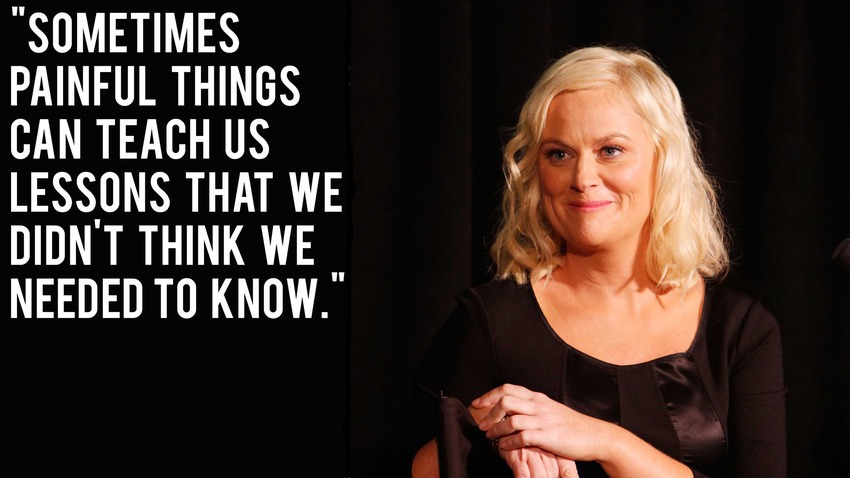
Amy Poehler

As painful as it was to have my shadows served up to me to “Yes And.” I also acknowledge that our darkness can teach us a lot and this is why I also wouldn’t want to pre-limit myself either in the tabooing of certain subject matter. As is often the way, how a subject is dealt with often dictates the impact of improvising around the topic. I have done some pretty dark things in improv that I’ve let affect me but I did them because that was cathartic for me in those moments.

A few years after my father died, I did a scene where I was a character sitting by an imagined father’s graveside talking to ‘him’. The scene had come about because a fellow improviser, who was also my friend, had endowed my character with a dead dad. As soon as the words were out of her mouth she apologised. I said it was ok and I meant it. I continued because I did not feel hurt by the course of this improvisation. I walked in with my eyes open and I had the agency within the scene to check in with my body to see if what I was doing was landing well inside me. In this way, improvising has allowed me to explore parts of myself that were ready to be discovered. It has also helped me take responsibility for them. If I had removed them from the table before the improv, I feel, personally, that I would have been doing myself a disservice.

“If we feel distress, embarrassment, or anger, we think we’ve really blown it. Yet feeling emotional upheaval is not a spiritual faux pas; it’s the place where the warrior learns compassion. It’s where we learn to stop struggling with ourselves. It’s only when we can dwell in these places that scare us that equanimity becomes unshakable.”

Pema Chodron

Sometimes I choose to walk into the places that scare me because there are nuggets of wisdom there for me to discover. However, I don’t want to feel forced there. The difference is choice. It’s agency. It’s owning your improv. It’s knowing the places you can go and the places you can’t. And the places you can’t go right now.

So if we do know we can’t go there right now, why not tell people?

Of course, if you feel comfortable doing so, tell people. I am not suggesting you must sit in silence with it burning a hole in you but I would caution that by letting your fellow improvisers know information just before the improv you do risk popping ideas in their heads. And I think we all need to be aware of that possibility.

What I am saying is that you are not obliged to open up to those who have not earned your trust even if they are improvisers. We need boundaries concerning our kryptonite not because we are armoured people, but because everyone is at different points on their journey. And acknowledging that allows me to honour where I am.

Brene Brown says to think of trust like a marble jar. You add and subtract marbles accordingly. Every relationship you have has a jar. With my regular troupe mates, the jars are brimming with trust marbles so my boundaries with them are different. I will generally be more open at check-in with them because I know I am safe to be, but even then it is up to me how much I choose to disclose.

One of my troupe mates said in check-in the other week that they were having a difficult day and didn’t want to go into it. I said, “Was there anything we should avoid improvising about?”, painfully aware as it left my lips, that if there was, them stating it, would be opening that door they’d just said they wanted to keep closed. I quickly corrected myself. I felt the discomfort of butting up against the clear boundary set in check-in through trying to establish boundaries for the improv.

A boundary can be kindness in disguise… the disguise of a badass fence. Tulips can so be badass.

Ideally, what I’d like to see up-top of improv sessions is the empowerment of our agency within scenes, encouragement for checking in with your body about what is ok and what is not in the moment, and a reminder of the license to leave a scene, time-out or throw away the ‘rules’ of improv when we need to. I don’t think it is always possible to preempt where your boundaries will be until you come up against them. I think we need to be considering how we communicate we have come up against a boundary from within a scene.

Instead of asking people to open themselves up to reveal where to shove a knife, we could explore how to empower people to take responsibility for their own boundaries in improv, to give them the tools to manage themselves when they meet one of their boundaries, to move a scene into different territory, to select which offers to respond to, and to not “Yes And,” when the answer should be “No.”

“Take students in an ecstatic, highly suggestible state, add social responsibility through group dynamics, sprinkle with rules and doctrine, stir in hierarchy, add a dash of authority, serve with tyrants, egoists, predators or narcissists and you have a recipe for disaster. We should be deeply concerned about rigid, rules-based teaching of Yes And and the Pavlovian response it creates. Yes And has been, and continues to have the potential to be, used as a tool of manipulation and control. Improvisers are trapped in scenes and forced into situations they aren’t comfortable with. They’re trained to feel they must go along with it regardless, all under the guise of Yes And. Any rule that restricts choices provides perpetrators with an opportunity. Another reason why it is vital to give improvisers the power of the tools, not the restrictions of the rules.”

Patti Stiles, Improvise Freely

In her book Improvise Freely, Patti Stiles gives a brilliant example of how she turned around a scene where her own empowered offer was dropped in favour of a crude lewd response using the phrase “Yes, And”. Because her own way of accepting that response took the scene in a different direction than the one her scene partner wanted things to go, he afterward accused her of not using “Yes, And.” Patti reminds us that “Yes, And” is one exercise in acceptance. It is not a literal rule to die by.

I’ve knelt at the altar of “Yes, And.”

I’ve ripped myself apart for “Yes, And.”

I’ve thrown myself on the “Yes, And” pyre.

It did not feel good.

We don’t often realise where our boundaries are until the moment our bodies let us know, so let’s keep the discussion around boundaries in improv going and reconsider how we manage up-top disclosures. We could make lists of all the things we don’t want to improvise about. Chances are they’d be long.

For me, taking responsibility for myself in my scenes meant taking responsibility for my improv and ultimately taking responsibility for myself. We make many choices in a scene about what to focus on. It’s not always easy to move a scene to somewhere else but it seems surprising how little we consider that as an option. We don’t teach it because it feels ‘bad improv’ and potentially controlling, but I would personally much rather my scene partner took the scene elsewhere than raked themselves through the emotional coals for the sake of fitting into the scene.

Sometimes you’ve got to move the scene into safer waters. No one needs to face their personal Jaws for their improv unless they choose to board that boat of their own accord.

Improv for Survival

After nearly two years, it felt amazing to put a show in front of a live real-life audience. We had completely lost touch with whether anything we were doing was funny. Had we got to the point where we just made each other laugh? Would it be like a pin drop as we muddled through creating the worlds that interested us but that no one else really understood? What was in store for us on that stage?

I was a different person from who I was when the pandemic started. I was certainly a different improviser. How would an audience react?

We held our breath.

On stage for our first duo real-life performance as Assimilate after two years in-waiting.

It had been a long two years.

It is already becoming harder to remember now what it was like for all the theatres to be closed, to have no stages to stand on, no real audiences to sense. My life had been defined by them and then they were gone, seemingly overnight. It was disorientating, disturbing, and traumatic.

And we are constantly being reminded we are not out of the woods yet.

Ironically, the woods are where I have gone when the claustrophobia of the pandemic has got too much. They have been my sanctuary. And it’s true, I’m not out of the woods yet; I’m still going there. The size and the longevity of the trees remind me how small I am and I need that sometimes. I need to remember we are all passing through.

I imagine years from now the question will be, “How did you spend the pandemic?” in much the way my grandparents’ generation used to ask each other how they spent the war. The pandemic is a very different thing of course but another big collective happening that has cut across all our lives. It has felt long and we are weary. Sometimes I look around now and think of all the practical things I could have been doing during lockdown but didn’t. I have to remember that I was actually quite busy, surviving.

“It simply divided my life, cut across it like that. So that everything before that was just getting ready, and after that I was in some strange way altered. It took me a long time to go out and live in the world again. I felt “alienated” in the pure sense.”

Katherine Anne Porter on her experience of having influenza in the pandemic of 1918

I tried to be kind to myself during the lockdowns. It was one of the biggest things I learned, a lesson hammered home to me while having COVID-19 and also in the aftermath of the virus. I didn’t know if I’d ever recover my health so I resolved to be kind to myself whatever happened. If ever there was a time for me to learn how to be kind to me, surely it was here.

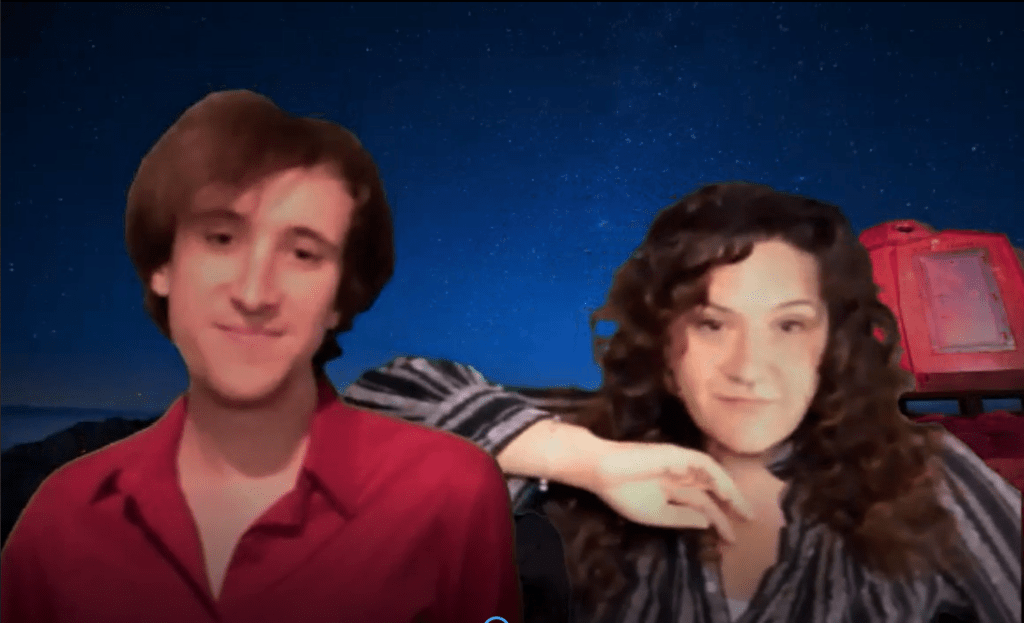
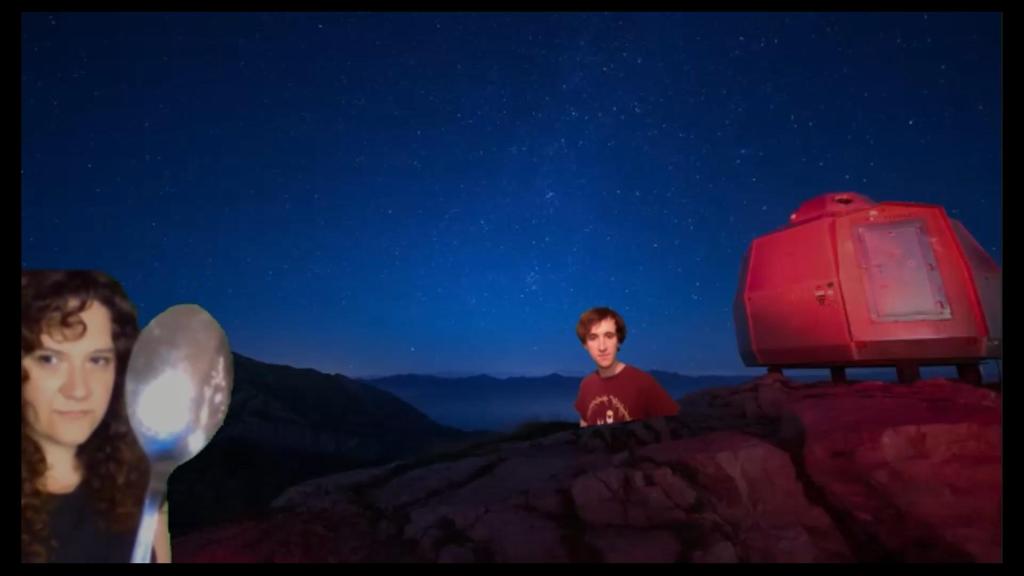
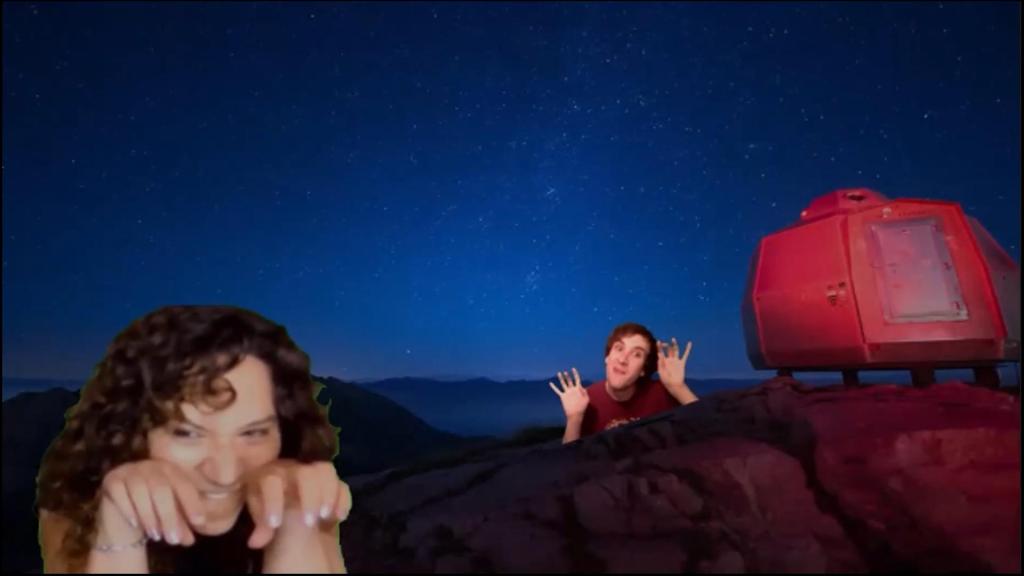
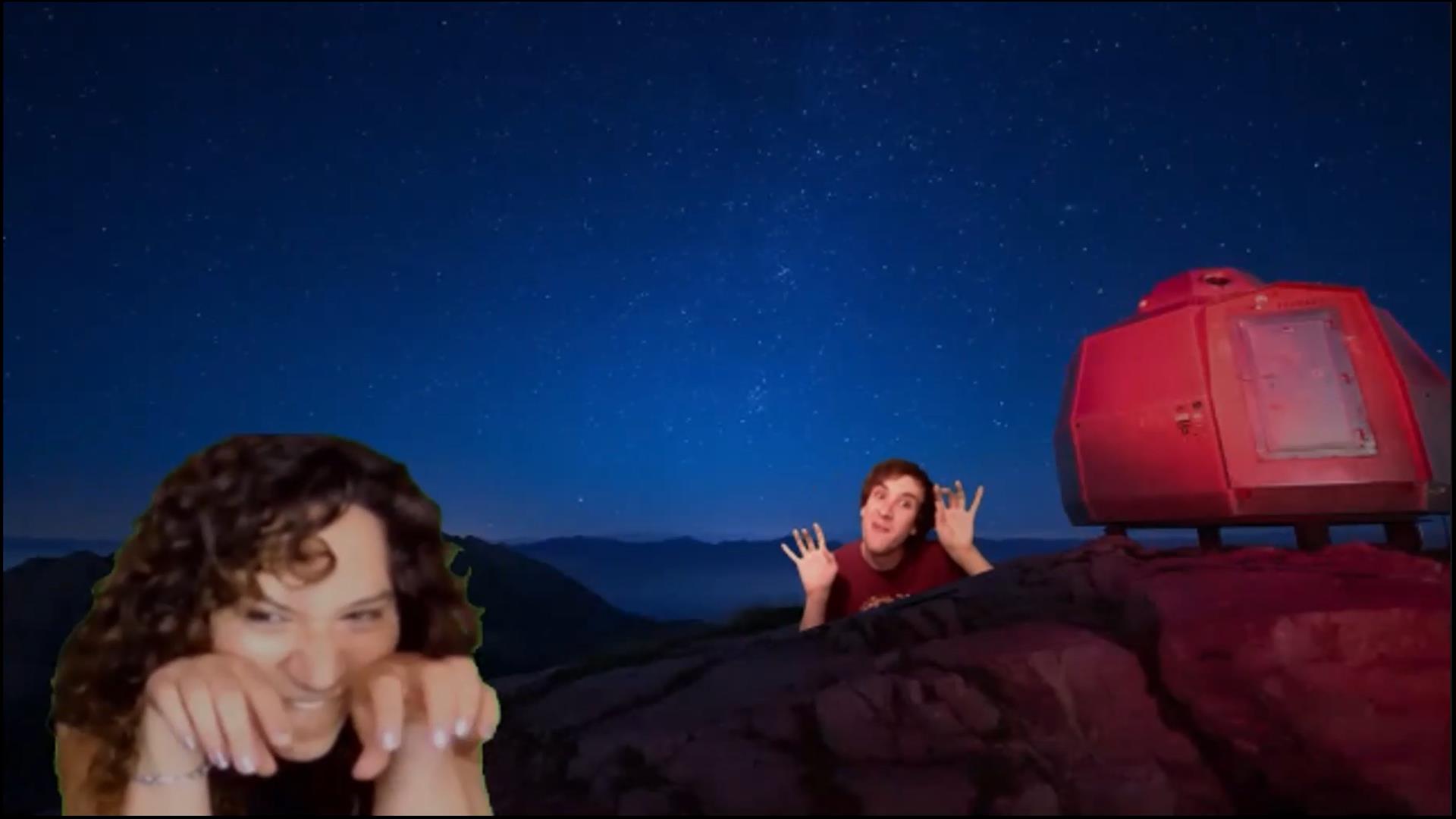
Separately beamed into the virtual performance space… which just so happens to be in space… a space in space. We’re just thinking about that.

During this period, we were barely allowed outside. Essential food items, medicine, and an hour max exercise a day were the only permitted reasons to leave home. Our worlds had become small and uncertain, uncomfortable and stuck. These were the reasons my duo buddy, Josh Hards and I applied to be part of a university study into virtual improv. After all, there was no indication as to how long any of this would last. And what else were we going to do with time?

For me, exploring the worlds of Virtual Director saved me from the monotony of everyday lockdown life. The software designed by Boyd Branch projected our images from our separate spaces into one virtual arena where we were guided by our director Boyd. You can read more about our engagement with the study here.

Improvising at a distance, and with a time lag, was challenging but at least it did allow us a chance to leave our homes in our imaginations. Some evidence suggests parts of our subconscious minds can’t tell the difference between real and imagined so perhaps this is why I feel I had a busy pandemic. Although we were separated by geography, seeing the image of ourselves placed into the same onscreen environment seemed to have the effect of making us feel we had indeed left the house on some level. We traveled in space and in time. We traveled through the air to create together, or at least visual representations of us did.

Josh and I came to realize, during the study into virtual performance, that to get the best out of online improv we wanted to lean into the things we wouldn’t be able to do in real life. A couple of months before the pandemic started we’d traveled together to Hamburg to do intensive training in sci-fi improv with Project 2, the inspirational duo made up of legends Katy Schutte and Chris Mead. It was because of this adventure that we’d started to plan a new improvised sci-fi show of our own.

We loved science fiction. It was what we’d set out to do in the before time so these strange unpredictable circumstances could play into our remit. After all, improv had now actually become sci-fi.

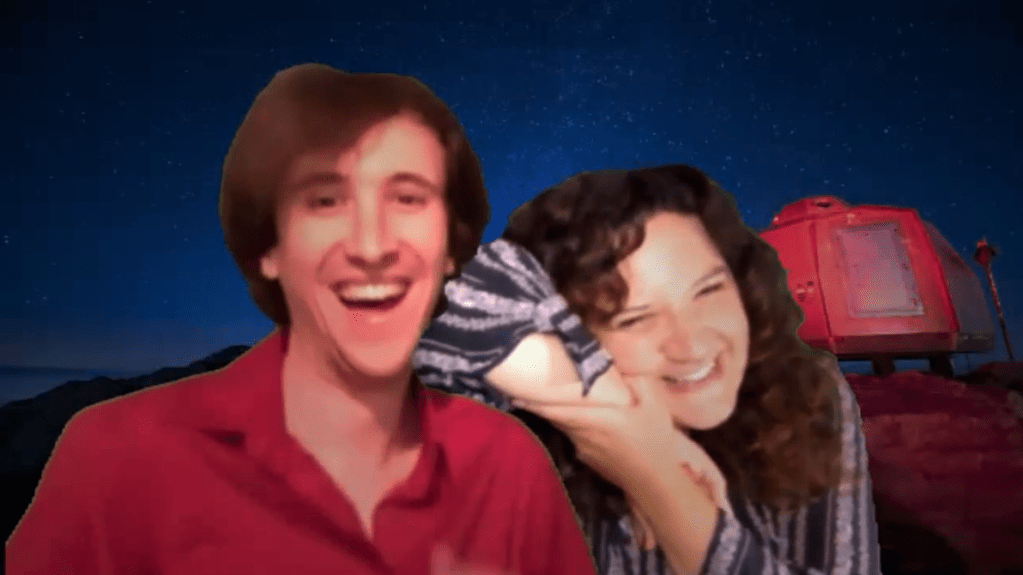
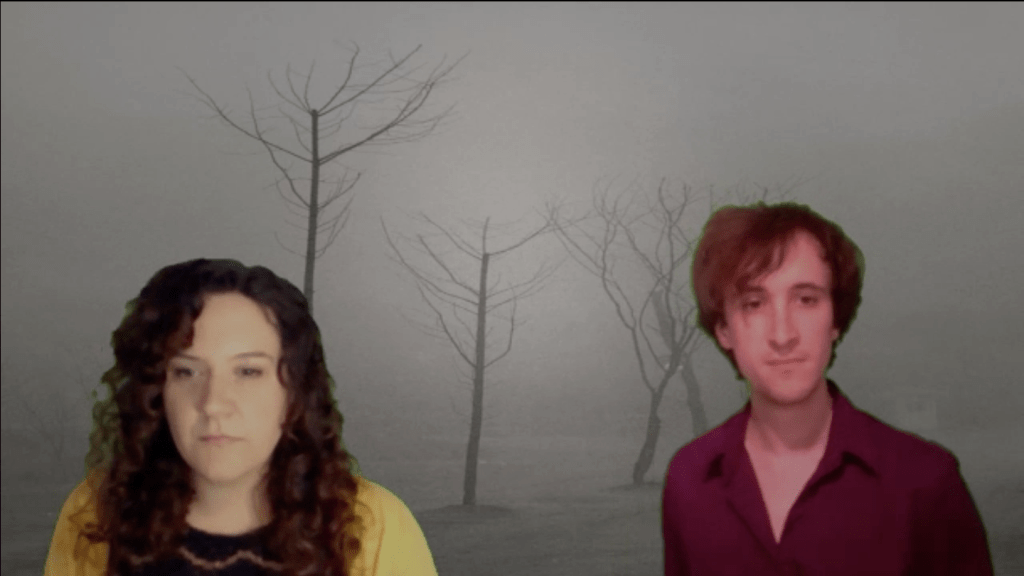
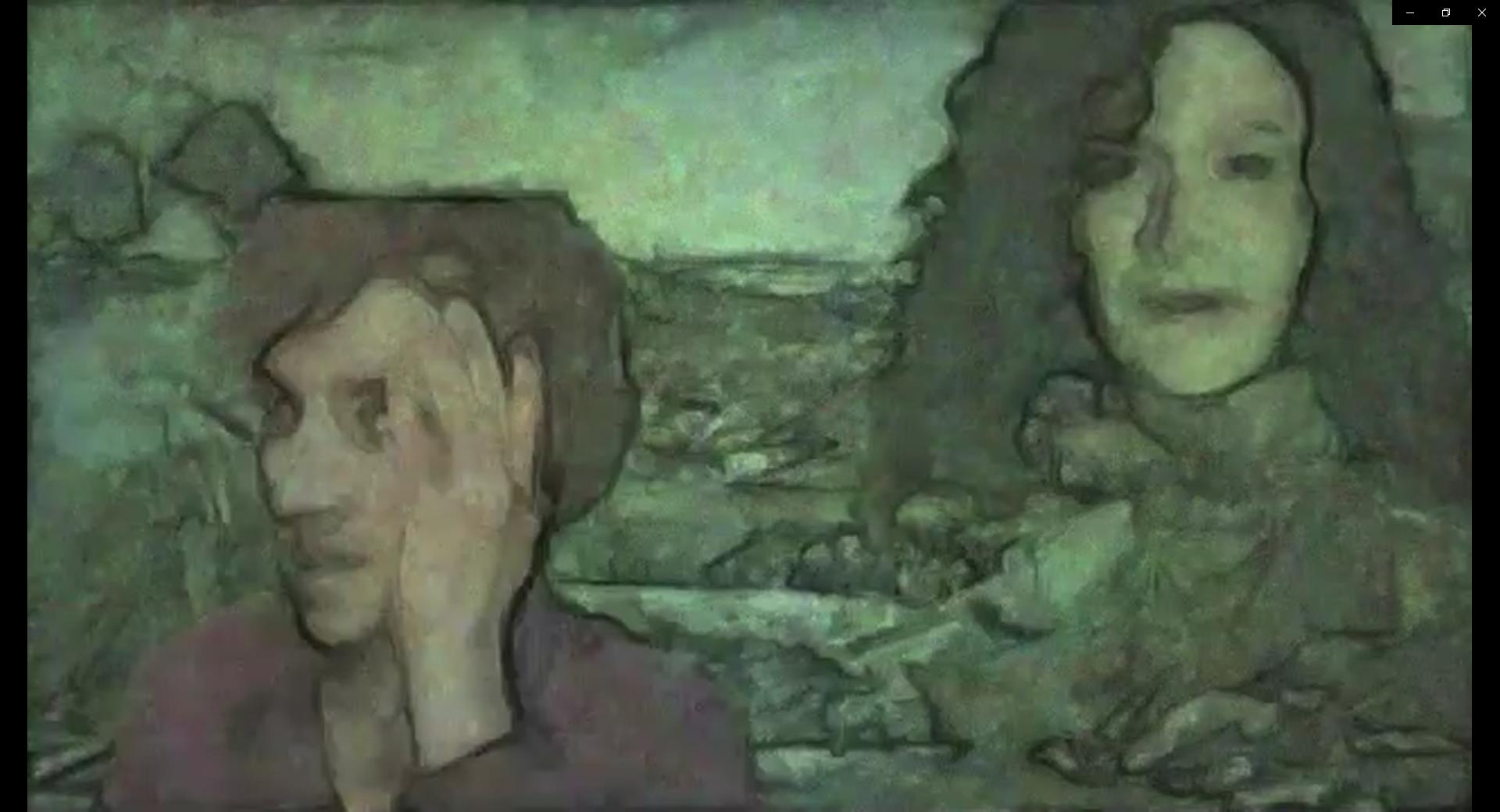
This meant with some creative thinking we could use improvising online at a distance to our advantage. There were visuals available to us now that could communicate our surroundings and even change our appearances without words. Our experiments with technology were given a huge boost working with Boyd Branch. He introduced us to using filters and we were so excited by them that we chose to use one for our first performance. It made us look stylized, like vampiric scruffily drawn avatars, and nudged us toward more eerie scenes and characters.

I think this also appealed to us because staring at yourself as you improvise can be quite a barrier to getting into a creative flow state. I suspect it gives the left brain too much to do as it tries to interpret what it’s seeing. In recordings, I would notice how much my eyes darted between my image and my scene partner. It revealed how distracted I’d become. Using a filter at least meant my image was then more of an avatar or puppet that only bore some resemblance to my likeness which created some more distance between my screen representation and me.

The audience for our inaugural online show had been invited into a closed Zoom room. Before they arrived, we spent some time warming up with another duo and they went ‘on’ first. This meant that Josh and I sat separated, alone, for 20-30 minutes waiting for our turn. This was a completely different experience from sitting together for the same length of time before our live show while watching another act. In real life, we still had an energetic connection. Onscreen this wasn’t possible so it had an impact.

Our first online show went into pretty weird territory. There was one scene we still laugh about now where Josh was in a bathtub and I was standing out to the side. I tried to scrub his back at one point but was spun all the way around instead as both the virtual director and I tried to figure out the logistics at the same time. It was a really strange scene but it’s funny how they are the ones that give you legacy laughs.

Was anyone else laughing at that moment? We didn’t know.

“Without reactions, laughter and gasps of audience, stand-ups can never be truly complete. There’s something strange about making jokes in a screen, with an awkward silence and occasional, disembodied laugh erupting from somewhere. [Milind] Kapoor says, “It’s a completely different thing to enjoy a band live versus listening to them on YouTube. You want the feedback of laughter. There’s an irreplaceable energy in the room when performing for an audience face-to-face.””

Grace Cyril, New Delhi, Hindustan Times

Given time, comedians performing during lockdown conditions opened up about how tough it was without audience feedback. This resulted, for some, in virtual audiences, like on BBC’s Mock the Week.

“It’s really helped the panellists and the comedians because it was flat without an audience. Now, some of them quite like being able to hear the audience clearly without having to be a few metres away from them.”

Mark MacDonald, UK Operations for BBC News

Our show was largely before those discussions. We had chosen to listen to the observations of previous performers who felt the mixed sounds coming from a virtual audience were distracting. We, therefore, opted on this occasion to perform with the virtual audience muted. This helped us to discover that not being able to hear any laughter or reactions increased our disconnect. It highlighted to us we were people isolated in separate rooms, cut off from an audience from which we felt a million miles away. Once I turned my camera off after the show I was plunged back into my lonely room in isolation. It was a long night trying to shake off my performance adrenaline because this energy had found no place else to go.

Performing online had its challenges but working with Boyd had given both Josh and me a lot more confidence and enthusiasm for experimenting with improvising onscreen. We brought lots of the things we’d learned during the study back into our Zoom rehearsal room.

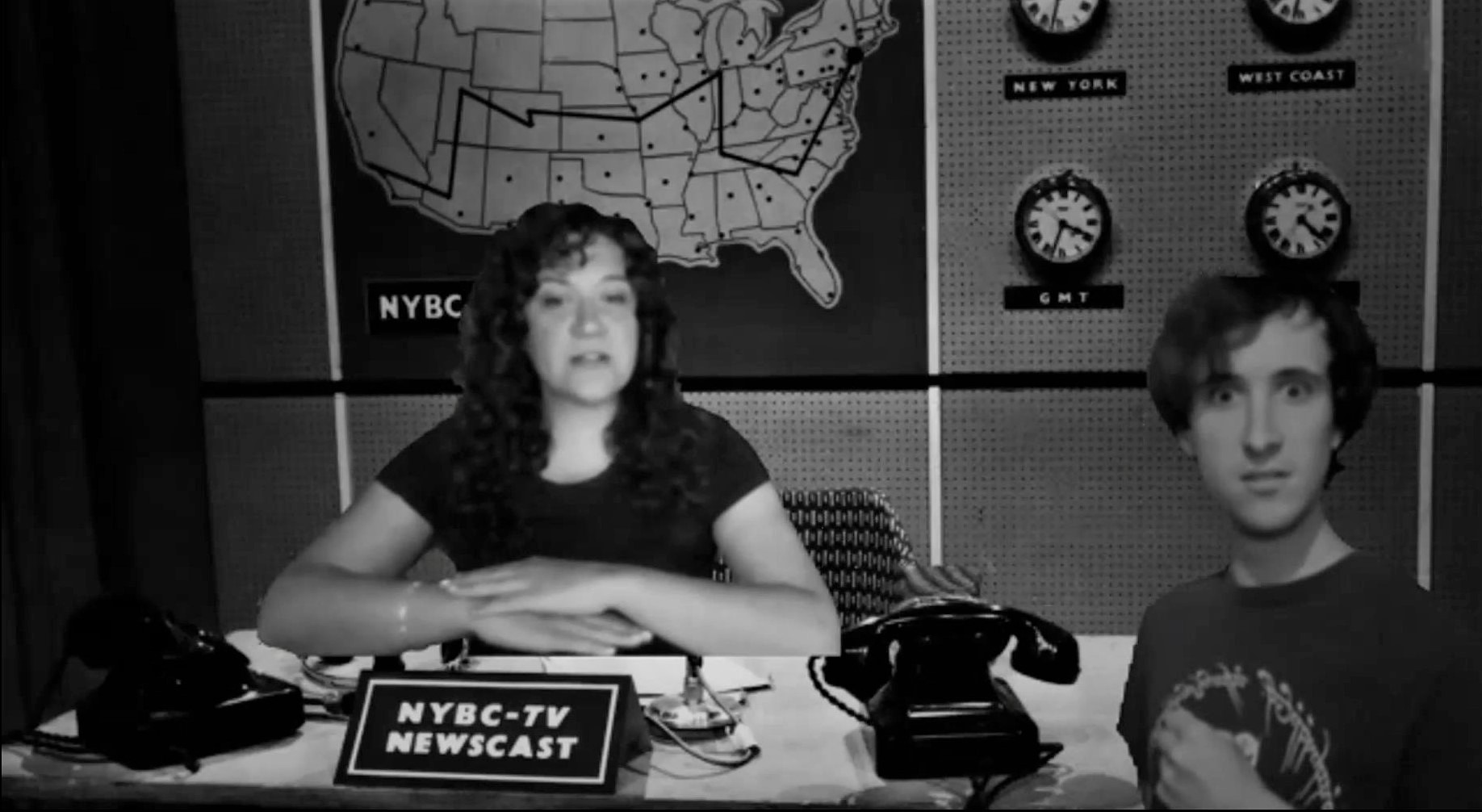
We discovered we could have lots of fun with filters, costumes, and props. We also really enjoyed using backgrounds to transport us to different locations. For science-fiction improv, this meant a whole other world of opportunity. We even tried splitting backgrounds and rigging up second screens to the side of us. An early scene we did this way was in a run-down tatty living room and was about a man with a robot second wife, which he had obtained after his first wife had died. It was moving but we realised watching it back I was looking too high up and far forward to meet Josh’s eye-line.

It took some adjustment in our setups to get it right so we could both appear to be looking at one another. Once we had, it created the impression to an audience that we were in the same space. Of course, we weren’t at all so it felt like a neat trick. We judged our scene Inventory to be the most successful using this technique.

Interestingly during that time, we played a lot of people in bunkers. We played people living in authoritarian states. We played people evading oppressive rules and regulations. We played people surviving. We poured out our frustrations into our characters. We lived vicariously through them. I’ve always been fascinated by dystopian story-telling but I think creating these worlds helped me cope with what was happening in real life.

The day-to-day living at this point in the pandemic fed into our art. It was a mash-up of nothing happening and everything happening. It was boring and sensational, dull and horrifying.

These so-called bleak times are necessary to go through in order to get to a much, much better place.”

David Lynch

Making performance art gave me a reason to get out of bed in the morning. It gave me a community. It gave me a support network that saw me through this time. It gave me something to focus on that wasn’t watching the death count figures rise or obsessively refreshing BBC news. I did those things to start with and then, exhausted, I let them go as my days became occupied with making. And making, as humans have always done in so many forms over our time on this Earth.

I remember once seeing an exquisitely carved figurine in the Oxford Pitt Rivers Museum. The guide told us it would have taken a ridiculous number of hours to make. At a time when people’s lives were shorter, it awed me anyone would devote such a portion of their life to making. It really must have felt like a meaningful use of their precious life.

It is easy sometimes to consider making art as trivial, but is it ever really if it gives us meaning, a reason to carry on through the days with no certainties? I think it would be easy to see the pandemic as this wake-up call to do something important with our lives, but who gets to decide what is important to us, but us?

“It is the poets, artists, and musicians that will carry us through the pandemic attacks into a new reality. They are the ones who tell us how to navigate, breathe, feel, think, enjoy, and fully live our lives.”

Erik Pevernagie

Creating and curating onscreen improv was time-consuming but it felt worth our time. Everything about it was like trial and error so we decided to accept that. We agreed the best way for us to perform online was going to be to record our scenes, review them, and then share them with an audience. This would allow us to keep a level of control over our art. We were then able to put out into the world the scenes with which we were most proud.

Our method helped us to feel less inhibited in trying new things. We were still learning after all. And some techniques we tried really did not work. Still, there was a lot of debate at the time about whether online improv had to be live to keep the integrity of the art form. We felt a bit sheepish we’d found another way that worked for us but we also felt that unprecedented times called for different ways of doing things.

We had huge amounts of fun using Snap Camera filters but sometimes it was too much for my computer. In one scene where I had giant moving butterfly wings, my laptop gave up trying to understand what was going on and I became a sort of inverted shadow butterfly. Of course, that gave us a gift to play with for the improv but it was visually very strange to watch back.

Snap Camera wasn’t consistent and we’d both sigh when suddenly a yellow circle would appear on the screen that meant it had stopped working. However, we were able to do some extremely fun things with it when my computer did keep up. Some of my favourites were when Josh and I played Ken and Barbie comparing each other’s kitchens, when we played a series of monsters for our Halloween special, and when we became sock puppets – a sock puppet mum talking to her ungrateful son who was off to sock puppet (presumably) university. I also completely cracked up laughing during a scene we called Berries where Josh had a head-distorting filter that gave him a very wide mouth and a teeny tiny forehead. A number of these scenes can be viewed on our Assimilate page.

Because of the technology involved in online improv, this actually enabled Josh and me to expand our minds further into the characters we could play and the rich worlds we could build. Many things were missing from our tool belt but there was still fun to be found. Boyd Branch’s study gave us a strong start to our adventures. I think it made us braver.

Our explorations with Boyd also led us – Assimilate – to ‘meet’ The Sudden Knot who performed on the same bill as us in that first online performance. They were also experimenting with this new mode of improvisation so we teamed up with Desi and Johan from Belgium/Bulgaria for some double-duoing. It could have been a surreal double-duo-date but we had improv to do… so it got even more surreal.

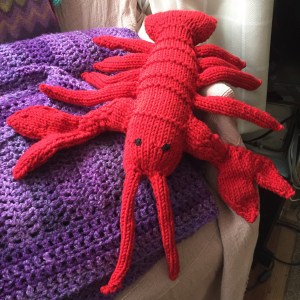
It was strange to be improvising at such a distance without having met in real life but it was also a thrill to play with a new fresh dynamic. The four of us created dark horror stories with a fairy-tale flavour. We released Gingerbread and Wake Up and Smell the Coral. If you watch to the end of Wake Up and Smell the Coral you will see one of my lockdown knits, Lobby the Lobster made a cameo. The idea for this came from taking an online class with Carla Keen entitled ‘We Can All Be Hedy Lamar’. It was about experimenting with techniques for online performance and some of Carla Keen’s ideas were great for feeding back into rehearsals. Using objects and toys was one such suggestion. Also voicing people in images was another that proved great fun to play with.

Lobby the Lobster was made a star regardless of his backward sewn-on arm. You can still be loved despite your imperfections. Maybe even, because of them. Lobby is not in full agreement.

Assimilate and The Sudden Knot then received an invite from Boyd to all come back together as a group for more fun with his virtual software. He’d developed it further by then so we were able to push the boundaries yet again by zooming in and using real-life backgrounds. From these experiments, we created a compilation of scenes that embodied an off-the-wall retro children’s show: Through The Cardboard Castle. It was incredibly fun to make together and is really quite bananas, and probably somewhat disorientating. I think it’s testimony to how we may have been going a bit stir-crazy at that point.

I do though feel Through the Cardboard Castle is rather a good tribute to this really weird time in all our lives. It sits beside our dystopian worlds rather well. They form an archive of a kind, a memory of this other world in which we found ourselves and created ways to survive… by creating art about survival.

There are times when being kind to yourself has to come first. And so I found a way to keep doing what I loved doing, even if that was in a way I had never done before. What we managed to create defied anything I could have predicted in those early days of resisting improv onscreen. I discovered online improv could be really fun. It just took thinking of it differently and searching for new things with which to play. I started to think of it less as the improv I knew and loved, and more as online spontaneous stretching of improv muscles.

Maybe that wasn’t going on a t-shirt.

Assimilate doing our best Mulder and Scully impression. The truth is out there… maybe… we’ll look properly when they let us back outside.

Suggest This

You get up onto the stage. You’re raring to go. You’re improvising, running a jam, or hosting a show. You ask for a suggestion. Someone calls back from the audience. You feel grateful someone is saying something. You feel you owe them. But the suggestion is gross. It’s smutty. It’s sexual. It’s unpleasant. It’s about shit or bums or willies or dildos or bondage or brothels. It isn’t the suggestion you want to do, or you want your troupe mates to do, or you want the willing participants at your jam to do.

But you take it because you feel you must.

Perhaps you are operating under the mythology that the quickest, loudest audience member is always right. Perhaps you are operating under the mythology you owe this voice for speaking. Perhaps you are operating under the mythology that this character in the crowd must speak for all the others. Perhaps you are operating under the mythology that you, or the people on the stage with you, can turn the suggestion around, weaving it skilfully into comedy gold. You will be heroes! “How did they do it?” people will say. “They’re geniuses!”

But will they? Or will they say you took a shitty suggestion and made it mildly less awful?

I’ve seen this shift attempted time and time again. And on more than one occasion I’ve seen audience members walk out. It’s a big risk. And we’re taking rather a lot of those already.

The truth of the matter is, we do get to choose. We don’t have to take the first suggestion. We don’t owe this unfiltered loudmouth anything. I have watched so many super-talented improvisers spiral down in a scene, song, or show because they took a shitty suggestion and tried to ‘improv improve’ it. I’ve been in those scenes, those songs, those shows myself. And it has not felt good.

It is easy to forget at the moment that we have agency.

There are a few schools of thought on how and what suggestion(s) one should get from the audience in order to begin an improv show. Some believe that you should take the very first suggestion you hear to prove to the audience that you’re improvising; you’re not seen to choose and there is very little time to plan. The thing is, after a certain amount of shows, there is only so much inspiration you can glean from “dildo”, “spatula” and “under the sea”. I used to argue that it was important to take the first suggestion and that it was a challenge to do something interesting with it, even if it was “brothel” for the four-hundredth time. The performers being delighted and inspired by the suggestion makes for a better show.

Katy Schutte, The Improviser’s Way

Why waste your precious efforts trying to crawl up out of a sewer pit, when you could put all that energy into starting from ground level, and reach far greater heights?

When we take a shitty, sleazy, sucky suggestion, we communicate to the audience that we are okay with that. Moreover, we are okay performing for them a shitty, sleazy, sucky show. The non-shitty, sleazy, sucky audience members lose some respect for us, and the audience member who made the shitty, sleazy, sucky suggestion receives the message that we approve, or we will at the least enable their behaviour.

When learning stand-up, they teach you about how to handle hecklers. These are loudmouth people in the crowd who will likely be tanked up and trying to impress their friends. Desperate to out-funny the funny person on stage, they want to rail-road things. They want attention. The longing for it propels them to open their mouths and push air out in any obscene way.

We get these in improv too. I was at a show once where an audience member kept yelling the word ‘twat’ for every suggestion. The first time, people laughed. The second time was mildly amusing. By the third time, we were all bored. Except for the twat-caller, who, not reading the room, just kept on trucking.

In stand-up, there’s a technique for this kind of disruption. When the heckler calls out, ask them to repeat what they said. Chances are the second time it won’t get the reaction it did the first. The element of surprise is gone. You can even ask them to repeat it again because you still didn’t quite hear them. Now they are just a person in the crowd repeating a shitty, sleazy, sucky remark that no one is laughing at any more. There’s no medicine quite like having to repeat your own bullshit until you feel like an idiot.

Ain’t that the truth?

Interestingly, I saw something similar to this in an improv context recently. The suggestion asked for was related to a flaw, and a nationality was called out. The audience reacted with a murmur mixed with grumbles, and the suggestion taker asked the person to repeat themselves. The suggester did not restate the suggestion, presumably being influenced then by the reaction of the crowd. I was excited because I thought, yes, this is how it could be done!

It makes sense in the context of what I’ve learned in stand-up, that this moment of opening up to suggestions from the audience will sometimes inevitably lead to the problematic suggestions bolting out like a frenzied beast of burden. We could treat these comments like a sort of nervous expulsion of hot air to be politely swatted away. There is a much better suggestion to come if we ride it out.

A noisy beast of burden making an icky suggestion to draw attention to themselves – “Get down from there; you’re making a scene… bad!”

A suggestion can really set the tone for the whole night. It can have an impact on the stage as a safe space, for ourselves, our fellow improvisers, and new people stepping into the improv space. Even the audience members are part of this exchange because they have to sit through whatever we go along with, so how do we get it right?

Sometimes what is a sucky suggestion to me may not be to you, so it’s good to talk to the other people involved in your troupe, show, or night. Also, consider at an appropriate time chatting to the audience to see what is cool with them. I was at an intensive recently when a brilliant young woman called out from the audience whenever she wanted a suggestion changed. I was so grateful because I didn’t want to see a scene start out with murdered children or people killing bunnies either.

Have a think also about how you take suggestions. It can be the difference between a cringefest and a great show.

Here are some suggestions… for ways to get suggestions.

1. Be discerning about choosing a suggestion – it’s a place to start, but ask yourself the question, is it where we want to start? Would we want to see that if we were in the audience? You don’t have to be cavalier about it. The show isn’t about boosting your ego. If the answer is no. Don’t take it. Ask for a couple of other suggestions. Take one of those instead. Remember the wise words of Katy Schutte: “The performers being delighted and inspired by the suggestion makes for a better show.”

2. Be specific about what you are asking for – some shows ask for specific things to minimize the risk of a problematic suggestion. The Showstoppers ask for locations and musicals. The Maydays, in their show Happily Never After, ask for a profession of one of your grandparents. It gives them a suggestion that has the right era vibes to play with their gothic feel show, and who’s going to suggest something sleazy about their grandparents? Not I!

3. Use predetermined words/phrases – one way to collect a suggestion is by already having a bank of words or phrases that would be appropriate for your show. Impromptu Shakespeare has lots of Shakespearean themes written on ping pong balls, like ‘twins’, ‘betrayal’, and ‘kiss’. When entering the theatre, the audience members are all given a word-branded ping pong ball. The audience is then invited to throw their ping pong ball into the ‘bard’s britches’ as one of the players dances about in stretchy pants. It’s a fun, silly start, and captured balls are then used as suggestions. Ping-pong balls. Just to be clear.

4. Run it through a third party like a suggestion generator – In their show making-up musicals, Do the Thing run two suggestions through their musician who merges them to give them the title of a musical for that show. This gives them a chance to get a unique idea but with a level of player control.

5. Collect suggestions in advance – this may be asking the audience to write ideas down. Austentacious collect titles of unseen Austen novels from the audience before the start of their show. I am not privy to what they do with them in the in-between time, but they can at least agree as a troupe to throw aside a suggestion that isn’t appropriate… even if that has to happen at the moment of the reveal. I have seen the Maydays do this in their show Confessions, where audience members write their misdemeanors on slips of paper and put them in a vessel before the troupe comes onstage. If a suggestion is that problematic, crushing it up and casting it aside saves us all.

6. Use something else for a suggestion – you may also consider going down another route entirely for your suggestions. In the raunchy Unbridled, directed by Heather Urquhart, a horse is selected from a chart, by an audience member. I was in a troupe that created a show based on the format Tomes, taught to us and directed by Chris Mead. In this show, an audience member selects a book from our previously not-inspected-in-detail collection of vintage fantasy novels. We then read the back of the book and consider the cover to generate suggestions for the show. When purchasing the books, I have been known to ‘lose’ from the pile the odd highly erotic fantasy (for discretion, I will say no more).

It’s fun to get creative with suggestions. In rehearsal sometimes we go a bit silly and ask for obscure things. We’ve asked for angles before – like 90 degrees – noises, percentages, and a month back it was Cuban leaders. Ok, that was quite a specific week but we did discover how little we knew about Cuban history.

Suggestions can be more than an exercise in engaging the noisiest, least-filtered person in the room. They can be a fun way to kick your show off to a flying start. They don’t have to be a drop-kick. Unless you want to do that with the shitty, sleazy, sucky suggestion as you cast it aside.

The Real World Return

I look around Beaconsfield Services – a sprawling hexagon-like building crammed with fast food outlets and bright moving screens. Outside it’s pissing it down with rain. The pitch-black void of the world is butting up against the tear-smeared windows. This is purgatory, the no-man’s-land between the improv mothership and that dirty rascal reality. On the way to the toilets, whole walls are covered with masses of different patterned mobile phone covers. People are ordering McDonald’s on huge vertical boxes a meter away from the counter. At the coffee place, customers are in stasis all staring down at their hand-held devices. Why is nobody improvising?

I stand trying to signal to Josh across the forecourt. He’s up on an inside balcony bit and I’m trying to get him to turn around and see that Ric is behind him. Maybe he already knows. So I change tactics and do a series of communications like long-distance charades that I hope explain Kathy’s location and why I’m here. Nope, don’t think he’s getting that either. The connection has weakened. There’s too much ‘real world’ in between us. We’re improvisers thrown to the winds. Is he beckoning me? He looks like he’s making an origami swan in mid-air. It could be a dance.

Between us are masses of people scurrying about like ants, getting themselves sustenance, wandering back and forth to the loos, loitering. Who are they all? Where are they going? Why do they look so unfamiliar? What makes them tick? Have they even heard of improv?

Josh still doesn’t get my hand signals or maybe he does and I don’t get his. Suddenly we are all disconnected. Suddenly nothing makes much sense. We are a paddle of ducks out of our pond. There’s no exercise to do in creating tension, or a game of the scene or song; there’s no sea shanty to sing or spontaneous dinner party to crash or supernatural Shakespearean witch to endow. I want to go all improvised David Mamet on this place and deep dive into a sweary rant:

The motherfucking motorway services with shitty tiled floors and filthy fucking tables. You can see the reeking sweat coating the walls. Who are these fuckers ignoring my hilarious charades? Why aren’t they supporting me? Bunch of goddamn real worlders, that’s who. “Normality”. Fucking “normality”. Who the fucking bloody hell wants fucking over-rated bullshit “normality” when you can make-believe to your heart’s content with deliciously creative people all day long? Give me badass creative improvisers every motherfucking day of the working week… thank you very much.

The Starbucks guy has written Lelo on my cup even though I am still wearing a name badge. One with a gleeful smiley face sticker.

I could use a hug.

It dawns on me why all these people might be looking down at their phones now and not at the grown-ass woman with a smiley face name tag stuck to the front of her cleavage.

Screw normal.

Yesterday I got to play a singing triangle. Who the bloody hell would choose “normal”?

It’s at times like this the rest of the world can feel alien. I can get caught up in stark contrasting ways of thinking. If you weren’t at the retreat, you couldn’t possibly get me, real worlder. I can feel a bit ashamed and misunderstood without actually having told anyone why I’m wearing a name badge. If they knew, they might even think improvising is kind of cool. And it is!

The truth is, improv is my normal and to me, it is home. I don’t much like having to walk away from it ever. Having to, sometimes makes me grumpy. Because to me, improv is no less weird than anything else humans do. Humans are the strangest creatures in the animal kingdom. Do you ever just look around and think: this is bonkers! What is all this stuff? Service stations. Roads. Self-serve McDonald’s. Hand-held information overload. Corporate overlords. Chairs.

Even chairs are pretty weird when you stare at them long enough.

When I immerse myself in other worlds for a while, the return often has me thinking along these lines. It’s like being quite contented living out of a suitcase and then being baffled by the sheer number of clothes suddenly at your disposal when you get back. It can feel overwhelming. I can’t wear all these clothes at once. I must remember: nor should I. I need to ease myself back in and also bear in mind the ones I took with me were my favourites.

During these times of readjustment from the improv mothership to the ‘real’ world, it helps me to feel less alien by reminding myself that improv is no weirder than anything else. It is just another thing that humans do and have been doing for a really long time. And I’m not talking about recent decades. I’m talking of improv as ancient.

“Around the globe, improvisation is performed by hundreds of theatre companies and groups, each with their own theatrical traditions and cultural identity. Improvisation is ancient! It’s linked to the Atellan Farce (300 BCE), to the Basque improvising ladies of the fifteenth century, French farce, or Commedia d’ell Arte (sixteenth century onwards). It connects to storytelling traditions in Ireland, Asia, Latin, America, the Middle East, Nordic countries and Africa, to name a few. Improvisation is present in the work of clowns, troubadours, jesters, bards, street performers, puppeteers, dancers, musicians and more. “
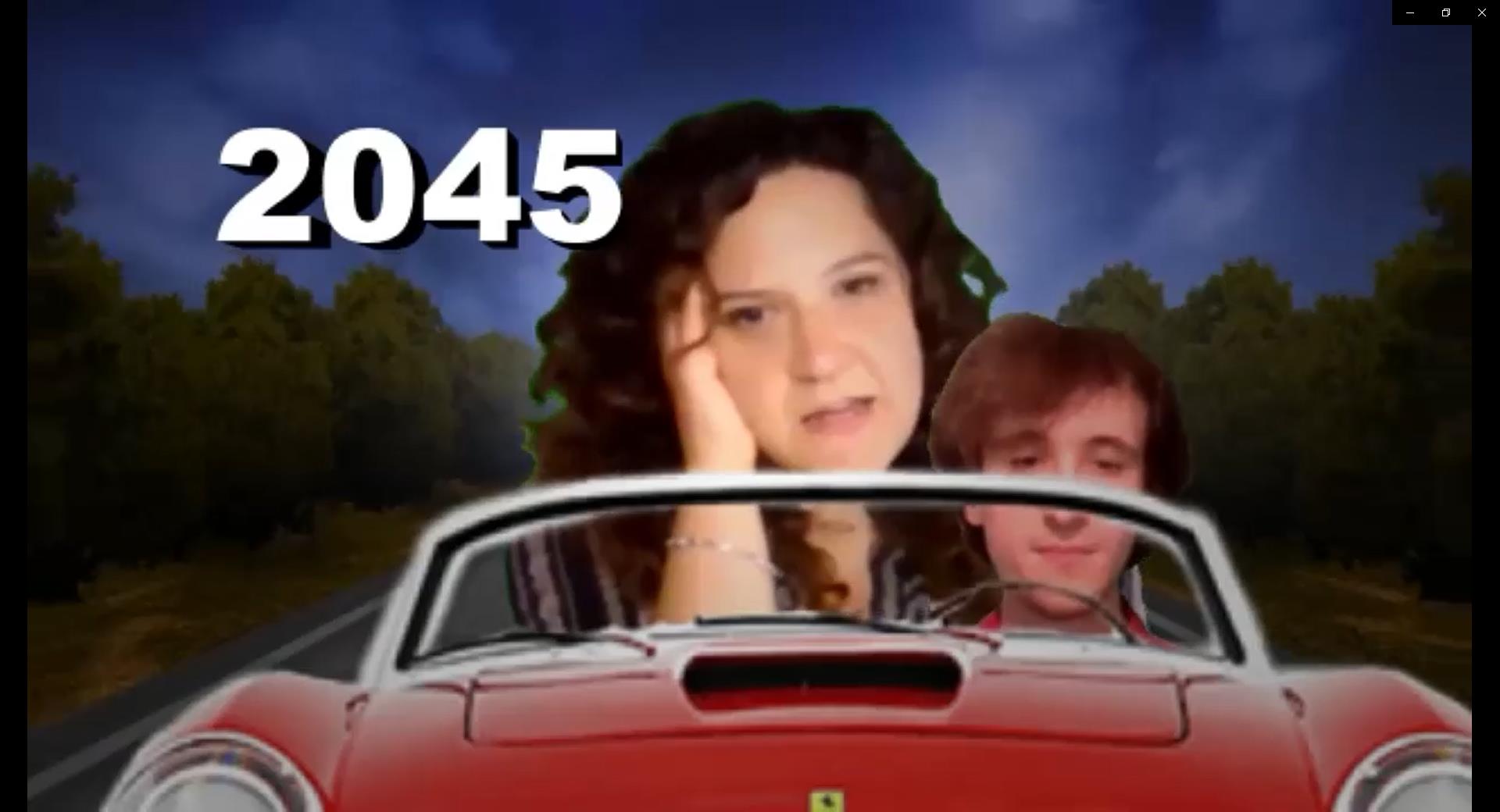
Patti Stiles, Improvise Freely

Going to an improv retreat is really no more bizarre than going on an all-inclusive booze cruise and not getting off the boat. We’re all humans picking out our favourites.

Still, sometimes I have wanted to ask: was it ok for me to be weird?

Was I actually being weird? Are we being weird? Maybe. But whose idea of weird? The sensible Victorian authoritarian voice of reason? Spontaneous drama as something weird, art as something weird, creativity as something weird – who makes those rules?

When I was at college a guy looked at my best friend and said she was “good weird”. He looked at me and said, “You’re weird weird”.

Rude.

My friend and I would laugh about that for years to come. Just what was this guy’s idea of ‘good’ weird and why did he get to decide? Well-behaved weird? Moral weird? Just the right amount of weird with which he was comfortable? That latter seems the most likely.

I know now that what my friend and I were, was creative. We had a connection that we’d worked on since we were 12 and we felt safe enough with each other to create freely and we would too; we would make up whole worlds together, building on thing after thing. We spent as much time as possible cooking up wild ideas about people and places and inanimate objects. We didn’t know what we were doing then… I reckon you know.

Finding people you can be your unlimited creative self with is a gift. Finding a place and a time to do that is a gift too. A gift we give ourselves when we improvise intensively, intensely, and/or on retreat.

I look around and know that Beaconsfield Services is not going to provide the space, even though some of my favourite improv people in the world are here with me.

I am grateful we have had a place – a glorious time carved out for The Maydays 13th Annual Improv Retreat. We have seized the opportunity to create, to chatter enthusiastically about creation, and to make as many wonderful creative worlds as time would allow. We have been awed. And we have witnessed creative bravery over and over again. We’ve watched risks being taken. We’ve seen beautifully rich spontaneous scenes brought to life before our eyes. We have grown.

The last night of the improv intensive I cried because I was so happy. I’d experienced so much joy and laughter and love – creativity had coursed through me; I’d felt appreciated, seen, heard, and alive. Over those 48 hours I’d fallen in love as a yeti with an elf, I’d played a rhyming owl and I’d sung as a sexy cat. I was overflowing with gleeful creative wonder.

By the time I get up to the Beaconsfield balcony, the others have reassembled and everyone is looking drained. Maybe they are feeling what I am feeling.

Toto, I have a feeling we’re not at the improv retreat anymore.

Maybe we’re all just really tired. But this debrief is important. It’s part of landing after improv: the chat in the pub, some circle time, a chance to check out and make sure we’re all exiting this intense time of creativity a-ok.

Improv isn’t a light activity. It’s not a surface sport. It’s not a peaceful solitary hobby you can pick up and put down while you’re watching Netflix. It involves crashing worlds together. It involves showing up and connecting through often messy loud negotiation. It involves guts.

So what can we do to land after lots of improvs, after an intense or intensive improv experience, after a retreat? Here are some things to try.

  1. Connect with your fellow intense/intensive improvisers – chat to the people who were part of your experience. They will get it; at least in part. They may not have been in that sexy cat class but they get what it feels like to have lived it and now to be landing like you are. If there’s a forum, join it. Reach out. Exchange messages, contact details, social media profiles. Set up those group chats. Share your thoughts and feelings. Keep the conversation going if you can.
  2. Accept that no one else will comprehend your glorious journey – they just weren’t there. It’s not that they don’t love and support you. It’s just they don’t fully understand and trying to explain to them how you nailed a chorus while playing a morose mushroom is just not going to mean anything to them. That’s ok. You get it. That is what matters most. And the good folk in your life will be happy you found happy… even as a morose mushroom.
  3. Listen to your body – What does your body need? Fluids. Food. Exercise. More bread? Honour it. You’ve spent some time in your head so let your body know you love it too. This also means sleeping. Slumber will help balance out all that glorious improv energy, the late nights, the early mornings, and digesting the massive quantity of bread (this retreat really involved a lot of bread). Get the shut-eye that your body is craving. The ‘real world’ (whatever that is) is easier to take on without sleep deprivation.
  4. Give yourself time – I remember one retreat from which I returned feeling emotional. I was so tired but I pushed myself to go out for an impromptu dinner with someone who hadn’t retreated with me. I got upset about the arrangements. And then over dinner itself, my head and heart were still in intensive improv-land and if I wasn’t talking constantly about my experience, I was resenting not talking constantly about my experience. Recognise when it is time to spend some time alone, resting up and smiling to yourself over the fun times.
  5. Check your notes – did you get it all down? Read over your notes and make sure it’s all there. Add in the fun things you played during that session or the things you saw others do. Did anyone make any moves you’d like to emulate? This will be such an inspiring reminder to look at later. I’ve nearly forgotten already what I played. A written record helps jog your memory so you can get all nostalgic through the year/s ahead.
  6. Keep on top of your schedule – with no one telling you when to eat, sleep, drink, and improv, it’s easy to let these things slip. On Monday I didn’t have dinner until 10.30pm. Today I had two lunches. I need to remind myself to focus on my timing. So acknowledge it is now likely up to you to take charge of what to do and when. And if you sit at the dinner table waiting to be served you might be waiting much much longer.
  7. Do something down to earth – there’s all that laundry to get through for starters. I know, boring! But do some things that make you feel like your feet are on the ground. Even intense/intensive improv stars need clean clothes and clean cutlery. Today I did the laundry AND the washing up. Good day. One day, sometime in the future, I might fully unpack.
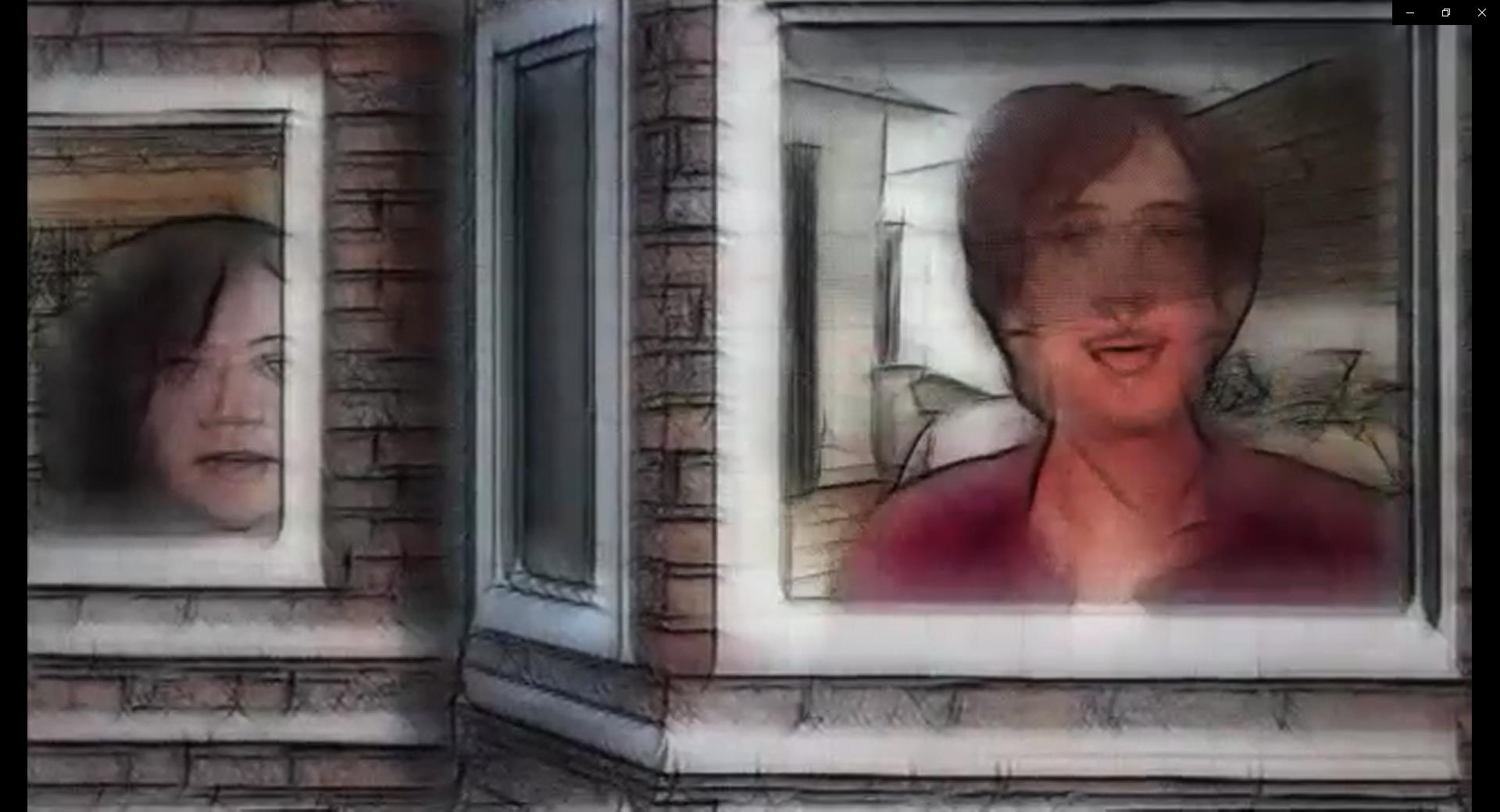
  8. Let go of regrets – Wondering if the improv you did was everything it could have been? It was. You gave it your best shot. You were learning so some things might not have worked. No worries. You were there and you were doing it. Nothing else matters now. I can get all caught up in thinking of all the things I should have done or said. For me, it’s thinking about where could I have been bolder, braver, and more ‘all in’. But the truth is I was enough. I am enough. I gave it all I had to give at every given moment. Give yourself a break and a pat on the back. If you want to make a note of any ideas that do spring up, pop them in your notebook under ‘try this later’. Then do something else completely different to get out of your head. I find yoga helps me or a walk in the woods.
  9. Give your inner child some love – mine is tugging at my hem saying “Why can’t we stay at the improv retreat all year around?” I hear you, precious. It sucks! Make sure your inner child knows there’s more creative fun to be found and you’re not drawing a line here. Dance a jig, colour something in, sing a song, splash in a puddle, stare at a bug. Speak kindly to the child buzzing about within.
  10. Create your next improv opportunity – you might want to book a class, get some improv pals together, or plan to take some exercises you’ve learned to your next rehearsal. You might sign up to the mailing list to be first to hear when the annual intensive rolls around again. Whatever feels good, remind yourself this is not the end of the ride. There is much more improv still to be done.

This landing calls to mind the improv shiver. After we play an intense scenario, an emotional deep dive, a character with strong motives, and “scene” is called, we have the impulse to shake it off.

Look everyone, it wasn’t me; I’m shaking it off now.

In a class about using the breath to inspire improv, I learned a new one from Jennifer Jordan. You look into the eyes of your scene partner/s and you clap your hands together once so it stings. The improv wake-up.

You can shake it off, you can clap it out, but for me, I don’t think it’s ever going to be easy to leave the improv mothership.

At times like this, the ‘real world’ doesn’t feel like my real world.

But we can’t go backward. There’s more fun to come so keep on improv trucking. I’ve spent a lot of my life living in a different time zone – the past or the future. But life isn’t there. It’s now. Right now. Now you get the gift of finding what to love about this moment.

Now is also the chance to keep the creative energy flowing. Don’t stop. Take all this beautiful intense intensive improv learning and let it bleed into your ‘real world’ improv. Whether you improvise once a week, once a month, or once a year, take all that creative curiosity and apply it to your motherfucking badass wonderful real life.

“Success is liking yourself, liking what you do and liking how you do it.”

Maya Angelou

So stay ‘real’: inside keep rolling around like a sexy cat, doing jazz hands like a triangle, and falling in love with your ‘real’ like a yeti with an elf. What else are you going to do with this one precious life?

Visit one of the three Starbucks at Oxford Services? Maybe. Or maybe…

… a lot more badass motherfucking improv.

We would like to apologise for all the motherfucking swearing in this blog post. Please blame David Mamet, and also Chris Mead, for teaching Improvised Mamet.

Hybrid Improv Forms

They could be called the world’s most lovable hybrid – just look at that furry face! They have the playful, shed-less temperament of a poodle, mixed with the fun features of an [insert other dog breed]. And those poodles have been busy. There’s the eskapoo, the schoodle, the bassetoodle, the jack-a-poo, the rottle, the saint berdoodle, the pomapoo, the shih-poo, the poochon, the whoodle, the schnoodle, and the Irish doodle.

And we’re just getting started.

There’s the yorkipoo, the groodle, the sheepadoodle, the cavapoo, the Bernedoodle, the doxiedoodle, the bossi-poo, the papi-poo, the poo-shi, the pyredoodle, the borderdoodle, the pugapoo, the poogle, and the scoodle.

Are we done here? Not even close.

As numerous, well-haired, and well-named as they are, the doodle clan has competition. There are plenty of other hybrid’s up for the top title: the liger, the mule, the beefalo, the guineafowl, the zeedonk, the grapefruit.

Even the humble peppermint is a hybrid of spearmint and water mint which added together makes ‘pepper’… for some unsatisfactory reason.

Glorious hybrids are everywhere, so why shouldn’t improv have some hybrid action?

I had a suspicion I was in store for an improv-form-hybrid treat when I signed up for a session on Forgotten Forms with the legendary John Hildreth. Now, if there’s one bit of improv learning I go gooey-eyed over, it’s forms. It’s embarrassing; I swoon. I love a form. I’d want to bathe in forms. Combine a form with bath salts from Holland and Barrett, and I’m there.

What do you mean, it wouldn’t be easy to stage?

There’s something about being given a structure to work within that feels invigorating to me. I used to think this was because I am a geek, but now I think there may be more to it. I’d like to take you on a scenic route which leads us back to more about this brilliant workshop. It’s just a very slight detour into some considerations about creativity.

When I was a Manager in Education, I was asked to run a session at a conference. I could choose what it was about – within reason. The history of the Groodle (Golden Retriever meets Poodle…) probably would not have gone down well with the Principal. The senior management team may have been expecting me to do a session about my specialism in Literacy, but I had other ideas. I’d become fascinated by a metaphorical beast called Creativity. What an elusive and complex creature!

While planning the session, I found research into the optimum conditions for boosting creativity. I decided to set up some activity stations around the room, so people could explore when they felt the most creative. There was a station where you assembled a jigsaw, another where you listened to the music of Johan Sebastian Bach, and another where you made complex origami animals. All the activities were designed to accompany the main mission, which was to come up with as many creative uses as possible for a brick.

Yes, a brick. Bear with me… before running off to play Eight Things.

It was fascinating to see the lists people created. It also really highlighted differences in creative thinking. My boss seemed to only manage to think of 3 uses, which I was so intrigued by. Was something holding her creativity back? Or was she so captivated by staring at the wonders of that brick?

Talking of staring at bricks, I went to the Royal Academy Summer Show once. One of the pieces displayed in the art gallery, a stone’s throw (a brick’s throw, if you’d rather) from Damian Hirst’s fly tank, was… a brick. It was with some other bricks. Together, they were arranged to make a bigger brick shape in the middle of the gallery floor. There was a plaque sitting by the multi-brick’s side. This was a piece of art.

I have to say, I had just been expressing my mystification with half an apple attached to half a pear (a rather quick hybrid), suspended from the ceiling, so the multi-brick made me feel I’d peaked too soon. But my architect companion explained to me just how special bricks were, about how they had been designed to be just the right size and weight to balance in the human hand to enable them to be laid correctly.

Wow… so is this a date?

There’s some evidence that listening to Bach can boost your creativity. Why not give it a try at rehearsals for entering and editing a scene?

As part of my session, I handed out Jeffrey Baumgartner’s list of 10 Steps for Boosting Your Creativity. Number 1 is listen to the music of J. S. Bach. If you fancy an experiment, try putting on some Bach in the background at improv practice. Does it make you feel more creative or just produce some really weird scenes?

Number 4 on his list, which is particularly interesting when considering forms, addresses the benefits of restrictions.

“If you are stuck for an idea, open a dictionary, randomly select a word and then try to formulate ideas incorporating this word. You’d be surprised how well this works. The concept is based on a simple but little known truth: Freedom inhibits creativity. There are nothing like restrictions to get you thinking.”

Jeffery Baumgartner

I wonder if this could be why structures, in improv, work so well. This may also be one reason we enjoy getting a suggestion from the audience. Not only does it demonstrate to the audience we are making it up on the spot, that it is their show, but also that it reigns us. When we can do anything in improv, it feels a giddy rush of possibilities. Where do we start? Anywhere? Overwhelm! I’m just going to have a sit down on one of these chairs for a bit.

In providing restrictions, which you’d think would be limiting, a form can perversely be less inhibiting to our creativity.

John Hildreth’s session was an unbelievably satisfying session for creativity and for a forms fan. He was teaching us not one, but two forms! Yes, two! And that actually meant three forms because there was the third form that was a mash-up of the former two. Through the doodle lens, it was as if he was teaching us how to be a poodle, how to be a schnauzer, and how to be a schnoodle!

You can imagine, I was close to fainting.

This beautiful beast of a hybrid, the LaRond-ommando, combined the La Ronde with a Commando. I had done a La Ronde before but had not met a Commando. The Commando is defined by a specific edit whereby the editor draws attention to the scene being edited by saying, for example, “In this scene, we saw two people eating in a restaurant… “

The second part of the edit is then to elicit a new suggestion from the audience. So this might look like: “In this scene, we saw two people eating in a restaurant; where else might we see food around people?” The answer might be anything from food substitute pouches on an International Space Station, to a packet sandwich eaten by the roadside, to duck pond (who invited that guy, right?). This then becomes the suggestion for the next scene. Duck pond it is.

In the LaRond-ommando this edit happens in a timely fashion in between La Ronde style runs. A La Ronde is like a relay of improv scenes where you, for the most part, keep the same character. Think a fancy Park Bench, without the bench.

You get lots of time in John Hildreth’s class to play with the balance of these forms under his expert guidance. It was a fabulous bunch of people in the class, and John was such a supportive teacher and really encouraging. Plus, I got to play a sporty dinosaur.

If you have the opportunity to do this session with John Hildreth, I highly recommend you seize it. He gave us really helpful tips on how to get the most out of the LaRond-ommando. He even mentioned the possibility of swapping out the La Ronde part for another form.

My mind was spinning Catherine’s wheels.

Ever since the session, I’ve been thinking about what other forms might be interesting to smoosh together. A Deconstruction and a Living Room… A Deconstruction Room? A Harold and a Monoscene… A Mono-rold? A Slacker and a Mockumentary… A Slackermentary? An Armando and a Pretty Flower… A Pretty Armando?

Siri, cancel my schedule; I know what I’m doing with the rest of the day.

Finding the Fun Improvising Online

The first time I did online improv I wanted to jab myself in the head with a fork. So I might feel something. Anything. Looking around at the other participants I suspected I was not alone. It was painfully slow, flat, and boring. I could see myself smiling inanely but my eye kept being drawn to someone else who looked as dissatisfied as I felt. She was mostly staring down at what was presumably her phone. Or a fork.

I did what I had been known to do before in these situations, and felt embarrassed, so dialed up my enthusiasm to a completely disingenuous level. By the time I turned my screen off, I was relieved to have ‘left’ and utterly exhausted. I also felt really down.

I then realised I had Covid-19. Due to being unwell, I missed the initial flurry of online improv classes. As I navigated post-viral fatigue, my troupe mates fancied meeting in Zoom rooms, but not for improv, for chats and quizzes. This felt right for us all at the time. I was grateful for the human ‘contact’. Their faces brought me relief. They were out there, untouchable and unimprovisable-with for now, but I could see they were still there.

During this period, watching online performances became a sort of salve. My improv duo buddy and I, co-ordinated tuning-in live for Andrew Pugsley’s very first Isolation. Each week, in collaboration with an improviser guest, he created a show accompanied by the musical stylings of Duncan Atkins. All parties involved, were in their separate homes attempting to create improv at a distance, on occasions, a very long distance. Sometimes the connections weren’t great, sometimes the time lags were problematic, and sometimes technology failed them. One special week with two guests, Ruth Bratt had to make a rather long phone call to Pippa Evans so she could hear what was happening.

Watching these wonders felt like witnessing people defy reality. The sheer determination to keep going against all the odds was inspiring. It was infectious (pardon the pun – too soon?). I remember propping myself up wearily in my bed as I watched Rachel Parris singing about stealing tigers… at least I think that happened, and it wasn’t a Coronavirus fever dream. I resolved then to myself that when I felt well enough I’d give this thing another try.

In the meantime, bearing witness from our separate homes, my improv duo buddy, and I would message each other. We would observe the moves, the making of the narrative, and the increasing technical effects. Every Friday night, we’d be ‘there’, wondering how long all this was going to last… the show… and also the government imposed, Isolation.

In the time before, Friday night was show night, so it felt a continuity (of some kind) to keep up with live improv gazing under these new conditions. And boy, could we have used some continuity! Everything had changed so fast. I don’t need to tell you, you were there, somewhere, experiencing something, no doubt pretty fast too… initially… and then very very very slowly. What happened to time?

Like many people, I was feeling cut off – isolated, funnily enough – and at a loss for what to do with myself. Having a fixture in the diary meant I had something at which to aim. Unlike watching Netflix, with online improv, we could offer suggestions to the performers through the comments function.

Now life really was getting sci-fi.

Over the weeks, I got familiar with the other audience members’ tastes. Some preferred a story to end with a wedding, some wanted alternative worlds, and some loved a pun. It was like a weird niche online family. A very distant one… for whom even meeting up during the holiday season feels a bit much.

I had lots of favourite episodes of Isolation but generally, the ones with mythical beasts and talking animals were what got me the most excited. It was revitalising to be spirited off into a different world as my inner child was lacking her usual joys. The last show ever with legend Mike McShane was the perfect finale. I wanted to stand up in my living room and applaud.

Actually, I did.

Well, it wasn’t such a stretch. I’d got used to clapping into the void. On Thursday evenings for a few months at the start of the first lockdown, we’d stand on our doorsteps in England and clap. Not like a slow clap.

Although we probably won’t rule that out for the future (for other reasons).

It was a proper round of applause because it was for the workers in our National Health Service. For visual reference on this clapping maybe imagine EastEnders… although my road is quite wide and long with driveways. Therefore, the inaugural time I stood and clapped on my doorstep alone, without being able to see anyone else, as one person observed me out a window opposite, probably wondering what the earth I was doing. And wondering if they should call someone.

Watching Pugsley week-in-week-out, inspired my duo buddy, Josh Hards, and I, so we started tentatively dabbling. We recognised that improvising online didn’t come naturally. There was much missing from our tool belt. And finding the fun felt more challenging. We were wondering whether it was worth continuing when we were fortunate enough to be invited onto a study into virtual improv through the University of Kent.

As part of the study, we had to have green screens or a wall of a contrasting colour. Redecorating seemed extreme and I couldn’t get any paint at this point – on account of no DIY stores being open… and also being unable to leave the house. So I looked through my stash of fabric I keep for an unspecified need in the unspecified future. Finally, the time had arrived!

More confirmation we are living in a distant sci-fi future.

I found a huge piece of bright green fleece material. It was perfect. I strung it up against a wall and set up a station with my laptop on a table nearby so I could stand up and move about in the camera shot. Josh found us some cheap ring lights we could each order online. It was starting to feel more like a professional operation… in my living room.

Being able to stand up and move more freely actually made a big difference to my enthusiasm for online improv and provided more options. For more on how embodiment can feed improv, check out Liz Peters‘ book Own It.

Before the first session of the study, we had to fill out a survey to discover how we currently felt about improvising on screen. If there had been a box to tick that said: “fork-in-face level dissatisfied” I would have ticked it. The options I did check added up to roughly the same sentiment. I started off thinking it was improbable that a virtual performance would ever excite me. I felt self-conscious and disconnected and couldn’t get near ‘the zone’ with a 10-foot barge pole… or even a load of lateral flow tests tapped together.

I didn’t have a barge pole hanging about either. Somewhere in the outside world was the nearest barge pole shop and it was also closed.

As our first study session approached, I felt nervous but determined to throw myself in as much as possible.

Lobby did not know why one of his arms had been sewn on the wrong way around. He would never know.

Well, why not? I hadn’t got much else to do. And my home was being filled with knitted companion animals. If I wasn’t going to be crushed under the weight of multi-coloured knitted lobster I was going to have to shift focus.

On entering the Zoom room I met Boyd Branch. He was a man behind a robot… not physically standing behind the robot like something out of the Wizard of Oz, but the brains behind a robot I’d seen improvising in a show the summer before. It was an honor to meet his face.

Boyd. Not the robot… I wonder what he’s doing now.

The robot.

Boyd would remain a floating head and shoulders until over a year later when we met him in the flesh at the Brighton Fringe Festival. It was extraordinary to discover he had legs and even a body. I didn’t recognise them, but luckily they were attached to his head. It was all starting to add up.

Boyd Branch had been developing software for virtual performance. As part of the study, he would train us in how to navigate it and then we’d perform a virtual show. We’d also reflect on the process throughout. I felt apprehensive but also fascinated. This was something really new. And during the monotonous Groundhog days of lockdown, it was such a welcome change of pace for which I felt very grateful.

The Virtual Director software enabled Josh and I to be beamed through our cameras, in their separate locations, into the same virtual space. Boyd would choose a backdrop for us. We could then discover the environment in which we were placed. He was able to move our images around within the screen, resize us, and make us appear from behind parts of the backdrop. In one scene, I jumped across the screen backward onto a bed, in another we scurried across a rock face and climbed on top of a moon pod, and in a third, I hung upside down from the ceiling, painting a fresco with my feet. All without having to learn gymnastics, fly to Mars, or become a half-bat hybrid. Boyd also had some vehicles behind which we were able to be placed, while the background moved as if we were driving said car/tractor/fire truck.

The software – Virtual Director – opened up so many new avenues. Boyd taught us how to online high-five, online hug, and online slap each other in the face. We experimented with passing props between us and more than once, Josh gave me a horrendous makeover while I turned my back to the camera. It was fascinating how seeing this contact on screen tricked my brain. I knew logically that Josh was not in the room giving me a hug. It was empty space. However, my brain still told me something was going on as it watched me cuddling on screen.

Boyd also introduced us to filters and this is something we would take enthusiastically into our own practice and performances. If you visit Assimilate you will find a lot of experiments using Snap Camera filters, including scenes where we are possessed dolls, monster siblings, and sock puppets.

You can see some of our experiments in Boyd’s virtual space here and for a run of scenes we did with a filter, here. The image on the right below shows the moment I realised that I was able to hold a bright green t-shirt in front of me so that my body disappeared. Quite a silly but surprisingly satisfying trick. Josh agreed.

Stay tuned for the next installment in online improv adventures coming soon...

Be You. No, thanks.

I can’t help but feel it’s a bit of a trap. And I don’t like traps. Never have. I made one once when I was on a Wilderness Survival course. It was a weird contraption made from a stick with a hole in the end, some string, and a loop of wire. It was supposed to catch a rabbit. The instructor said it was more likely to catch an elephant.

I believe that was his way of saying it was too big.

But, as he kept reminding us, he’d lived with Inuits and learned their ways. Apparently, that gave him permission to be a jerk.

Not the actual instructor… so potentially not actually a jerk.

I enjoy telling my outdoor pursuit stories because they seem to surprise people. Maybe I don’t seem very woodsy now. This morning I was looking through a box of keepsakes and found the twine I made barehanded from stinging nettles. And I thought wow, who was that person? I mean I wouldn’t have chosen then to do it that way; I would have worn gloves, like any sensible person, but see the above instructor’s details.

I’ve tried on quite a range of pursuits, outdoor adventures being some of them. Some I have nowhere near had the skills for. I once constructed a pyramid bow with exceedingly few carpentry skills. I once did a military assault course and could barely put my arms down for a week. And I once went sea kayaking with a river kayak and just went around in circles.

I did improv.

I suppose I rather enjoy the feeling of being out of my depth and having to muddle through. Actually, I’m not sure ‘enjoy’ is always the right word. Maybe I am drawn to it like a strange moth-like creature on a search to discover that elusive substance from which I am made. What is me?

I’ve been reading a book recently, called No Self No Problem. It’s about how neuropsychology is catching up with Buddhism in some of its teachings. The writer Chris Niebauer presents that our sense of self is an illusion created by the left side of our brains.

“Perhaps the reason we can’t find the self in the brain is it isn’t there. Yet even if we accept as true that there is no self, we cannot deny there is still a very strong idea of self. While neuropsychology has failed to find the seat of the self, it has determined the part of the brain that creates this idea of self…. Mistaking the voice in our head for a thing and labelling it “me” brings us into conflict with the neuropsychological evidence that shows there is no such thing… Taoist philosopher and author Wei Wu Wei…writes, “Why are you unhappy? Because 99.9 percent of everything you think, is for yourself – and there isn’t one.””

Chris Niebauer

Niebauer demonstrates how the left side of the brain is an interpreter, framing and reframing our experiences, writing and rewriting stories about ourselves. If certain behaviours don’t fit with its stories, it may choose to use some ‘interpreter’ license. It may just choose to ignore the offending article.

While the left brain is interpreting, the right brain is just doing its thing, its creative, emotional, intuitive thing.

There have been lots of studies surrounding this work but a particular one I found interesting concerning improv is one whereby test subjects were given two stacks of cards to choose from. On each card was a financial win or loss. They were told to make as much money as possible during the time allotted. One stack of cards contained big wins but also big losses. The other stack had small wins and almost no losses. It generally took fifty to eighty draws of the cards before subjects started to consciously see that drawing from the second stack was more beneficial.

However, test subjects started to sweat when the first stack was chosen, after only ten draws. Some people never worked out the system but even they still got sweaty when the hands of the dealer moved closer to the first stack. This study suggests the right brain has an instinct before the left brain can catch up. In improv terms this particularly makes me think of editing, when your feet know you should edit a scene far before you get to thinking – ‘I should really edit this scene’.

All this no-self-concept might send some running for pitchforks and setting light to livestock. For me, I’m kind of relieved. I never really felt like I had much of a sense of self so the pressure is off! Maybe I’m not meant to find one thing I’m supposed to be doing with my time either. Maybe I’m not meant to be a [insert noun].

“We’re being told to become a noun and the vitality of life is in staying a verb.”

Mark Nepo

Phew! Mark Nepo gets it. He was on Magic Lessons – Elizabeth Gilbert’s podcast about creativity – talking about how when children express themselves they are told they should be something. If they are singing on the playground, an adult tells them they should be a singer. If they are planting seeds, an adult tells them they should be a gardener. If they are running a diner under a tree and making mud pies, an adult tells them they should become a terrible chef.

It’s kind of insulting because they are already doing that thing and someone is telling them their efforts are not enough and they have to do more to be ‘something’ and make the grade.

When you are a noun you also can get caught up in trying to defend yourself. I experienced this a great deal when I was a teacher. In Britain, teachers are always to blame for everything (in the press, from the government, from parents, from managers – no one likes a teacher, except sometimes students… but generally not even teachers like teachers), and you get tested every year to make sure you are still a teacher ‘adequately’. There was a grade called ‘satisfactory’ which if you received it, you faced a long process of trying to improve from ‘satisfactory’ before you got fired… for being ‘satisfactory’.

Being a thing, being a noun, can make us feel we have to defend ourselves. We have to prove we deserve the title. We have to be doing that thing regularly. We have to be competent at it. We have to be recognised.

I’ve never felt comfortable choosing a noun. There are so many things to do in this world. I mean I adore improv. I’ve been doing it for years and it greatly enriches my life. But would I get a ‘yes, and…’ tattooed on my body? I would not. ‘Follow the fun’? Hmmm, no.

I always felt a great envy for people who got tattooed. How to be so sure of the consistency of one’s tastes and character? How to be so sure of one’s self?

When all that engraving is happening, I’m next door trying on hats. I have big hair, a big head, and a big problem finding hats to fit. If I didn’t enjoy trying them on, we’d have a big problem.

And it’s the trying-on-hat effect that I love about improv. I love to try on another skin. Who’s this person? What do they want? What’s their deal?

The extraordinary Neil Curran considers long-form improv to be pretty much the stage practice of Quantum Leap – a TV program starring Scott Bakula, where his character Sam Beckett gets stuck in a science experiment that for some mystifying reason has him jumping into other people’s bodies to right their ‘mistakes’.

Why would anyone invent this? Good question. I hear you.

At the beginning of each jump, Sam Beckett knows very little, if anything, about the person he has temporarily become. So it is, in long-form improv. We are there in the scene and we have to work out who we are in that moment and why we are there. And unlike Sam, we don’t have a womanizing hologram side-kick and unreliable computer to tell us anything about what is going on. Phew!

We just have our equally clueless scene partner. Hooray!

Check out this video to hear Neil Curran talk about the Quantum Leap of Improv.

I love Neil Curran’s analogy, just as I once loved watching Quantum Leap. In an improv scene, you may not always find yourself as a character you like but it’s up to you to find a connection with that character anyway. And in doing so, reveal to the audience, the character’s humanity. Perhaps our mission in long-form improv is to find this nugget of human in any scene and expose it to the audience before we can leap into the next unsuspecting character and scenario.

Playing other people, creatures, and inanimate objects, has helped me become more settled in my own skin. This week I played a pure ball of light. It didn’t have anyone to talk to and was floating about in a vacuum. Without anyone else to help it work out its edges, it could have been anything. Maybe in working out who I am not, I find myself closer to working out who I am.

Or maybe it just matters less.

What I am doing becomes my focus. For me, I feel my left brain is distracted during improv from its usual self-story rehashing. It is channeling all its narrative powers into working out what the heck the story is that is building in the scene or show. And my creative intuitive right brain is then free to be firing in the moment, with less meddling from left brain chatter.

“The intuitive mind is a sacred gift and the rational mind is a faithful servant. We have created a society that honours the servant and has forgotten the gift.”

Albert Einstein

Much of the Western World seems to want to tell us who we are. At the very least it wants us to pick something and ‘be’ it. When we do, it makes us easier to box and so to sell to, manipulate, and exploit. In this way, I see improv as a little rebellion against the big mass of ‘be who you are’ media and influences. I feel most myself when I’m practicing improv. Perversely so, in the process of playing being different people, I feel most at home.

And what of Sam Beckett, leaping about being other people? Hoping the next leap would be his leap home. Did he ever get there?

He did not.

The series got cancelled so they added a line about him never getting home. The end.

He’s out there somewhere still as if jumping from scene to scene to scene…

In Quantum Leap, Beckett, played by Bakula, was putting right what once went wrong. There’s something rather sticky about obsessively correcting other people’s mistakes, isn’t there? No wonder that computer was always breaking down. What a task it had to work out what would be considered a mistake and what wouldn’t be. It made younger me pretty scared about doing anything ‘wrong’. What if suddenly Scott Bakula would appear in my skin like, “Stand aside, missy, I have your life to correct.” Rude.

And when Scott Bakula was doing his thing, where would I be? Maybe I’d be Scott Bakula… as if Scott Bakula is a holding space for all the people who are shoved out of their lives to wait for him to be finished in their skins.

He does probably have a nice swimming pool. Still, leave it alone, Scott Bakula! I’ve got my own leaping to do.

Leap Responsibly. And may you put right the scenes that could go wrong.

A Cure for Writer’s Block

A surprising number of people claim writer’s block does not exist. What a strange thing it is to suggest that something you have not experienced, can not therefore exist. It feels as weird as declaring love does not exist or happiness for that matter. Can you imagine the uproar in claiming there is no happiness?

A friend of mine stated firmly to me once that writer’s block did not exist. She said writing just required mindfulness. I was so angry I could have spat at her. Not because she was being mean – she wasn’t trying to hurt me – but because it was so personal to me in that moment I felt like my reality was being denied. If it wasn’t writer’s block, why couldn’t I write? What was I doing wrong? I was frustrated and furious and ashamed and I didn’t even understand why.

For me, my writer’s block started when my father got sick – very sick, dying sick – and my head got so jumbled up about that, that when I struggled to imagine stories my brain had so much chaos it couldn’t find the space. I was like a wombat in a washing machine, in a whirling drum fitted with a million flashing alarms going off randomly.

I was trying to do a Master’s Degree in Creative Writing at the time – the same time as being in that washing machine as a wombat – so giving myself a break wasn’t an option. So I pushed. I pushed myself way beyond the boundaries of reason and self-care. I pushed until something snapped inside me. And then I pushed some more.

Unsurprisingly, this resulted in a phenomenon whereby every time I sat down to write, it didn’t work. I didn’t work. I would feel like I had a hive of wasps inside me and it was so uncomfortable I would have to get straight back up. Over time this feeling got less waspy but I still had ants in my pants. The great wave of ideas I’d once had for the starting lines of stories had gone.

I have to say, it has not ever really come back to the intensity it once was. But I’ve now made peace with that. And probably it is a good thing. At one point it was hard to walk ten paces without an idea for a story popping into my head and I think that’s probably not healthy… it is really inconvenient.

But I do write now. I sit down, sometimes for hours, and I write. This year I wrote a novel. So how did I get from wasps in my gut, and ants in my pants, to here, writing again? Well, there have been several things. Hypnotherapy helped. Sitting with uncomfortable feelings was important too. And yeah, if I am honest, some more mindfulness was actually pretty useful. But something extremely helpful in improving my relationship with creativity is… drumroll, please

…Improv!

I tried improv at a time when I was so frustrated at my inspirational block that I’d convinced myself I wasn’t a writer anymore. I had this idea in my head that I was fooling everyone I was still writing but I just wasn’t. And at that rate, I probably never would. I was terrified to even have an idea. I’d become so precious about the inspiration that the stakes had become really really high. I couldn’t possibly live up to the enormous expectations I had placed upon my pen.

Loosening up and letting things go

In some ways, improv feels quite the opposite of writing. With writing we are recording, we are preserving, we are leaving a mark (or many hopefully). With improv, we are throwing ideas into the wind and watching them blow away. Sometimes, when we are creatively constipated, I think that is exactly what we need to do first: get out all the detritus, the clogged-up hair, and grease. Improv can do wonders for washing out the pipes.

Inspiration in. Expression of inspiration out.

A simple formula. It can be quick, like melon traveling through your digestive system. In. Out. Job done.

Making room

When all the ideas get backed up, it feels like there’s just no more room. For me, it was like all those ideas were trying to get through the doorway at once. They had got stuck because there were just too many of them for one frame. They weren’t even sure if they wrestled their way through into the hallway, they would be welcome, so there was safety in numbers, stuck in the limbo state of being trapped in a block. So there they stayed fighting amongst themselves about who would be receiving attention next, being quietly confident it would be none of them. When I gave them a new creative outlet, some of them started sneaking through. I did a scene where I was a character talking about a father’s death. I did a scene where I was a lost child. I did a scene where I was a broken umbrella. I didn’t know this at the time, but I now know I was shifting some of those stuck ideas. I was making space.

Choosing

We can’t do all the ideas at once. In improv, we are forced to make decisions. If we don’t, nothing happens. So having to make choices about where a scene goes is also really good practice for choosing which stories to write. Because some ideas make shit stories and we need to be able to acknowledge that and wave them along. Improv is also great I find for inspiring the creation of stories that move. I used to write so many characters that just stayed in one place. It sounds quite funny now thinking about it but that is where I was at… with lots of characters standing around in limbo, looking at me, shrugging and saying, “Yeah, so, what now?” In learning the skill in improv of moving things along, I saw it creeping into my writing. It gave me the confidence to choose what was going to happen and also what was going to happen next.

Being less precious

Practicing improv helped me to see that there are loads of ideas flying about and some of them will get done and some won’t. Some will wait to be heard and some will fly off to somewhere else. Elizabeth Gilbert includes an amazing anecdote in her book Big Magic, about how she had an idea for a novel, conducted lots of research, and then for one reason or another, she put away all the notes in a drawer to work on later. That later got much later, and later still, until eventually she was having a chat with another writer and discovered that this other author was writing none other than that drawer book! They hadn’t discussed the idea but somehow it had passed between them. It might sound devastating but I find it oddly liberating. What a reprieve that we don’t have to feel guilty about the things we don’t write! In improv, there are also things we think of but for one reason or another, they don’t get out into the scene. Lost lines. Lost character explorations. Lost moves. And they are lost forever. We can either let them haunt us or move on and find others. There is always plenty to do.

Doing something

I had started seven novels and didn’t know which to finish writing. It took me years to pick one and in the interim, I would create more starts. Because I’d spent ages trying to decide which one would be the most important to LITERATURE (to be said in a booming grand voice), I changed tactic and picked the dumbest one. This one was the least serious and would be the most fun to write because it was silly. It was even sillier than when I started writing a space drama that took place on a boob-shaped spaceship (one day I’ll finish that one too maybe).

I wanted to see what would happen to my writing if I just followed the fun. And this is improv thinking again, sneaking across the divide. It’s my spirit of silliness that once I felt made me insignificant. But thanks to improv, I have learned to feel differently. So I wrote it. That silly novel idea. My thinking by then: this does not have to be good. It just has to be written. If I can get this written I can learn the lessons I need to learn from having written it. There is no other way than to do the thing you need to do.

Letting Go of Perfect

You can spend a ridiculously long time wanting to write the most perfect paragraph, wanting to do the perfect scene but if you don’t step forward into the space and just get going it isn’t going to get done. What I learned to love about improv is that it fucks perfect in the face. There are a million different types of perfect scenes and you’ll never know if you can pull one off if you don’t get on with it. One person’s perfect scene isn’t another’s anyway so fuck perfect! Practicing improv helps us practice fucking perfect, imperfectly. Because in improv you have to fuck perfect, imperfectly… A LOT. And it is this practice, we can take into other art forms. I believe giving ourselves license to be shit to start with is the key to doing much art.

Collaborating

Writing can be a very solitary pursuit but practicing improv with others is a great confidence boost to your ideas. You can discover that your ideas are pretty good and sometimes so good someone else has them too, even at the same time, and you can create that dynamite idea together. And even if that original idea needs some work too it can help you see the potential. Katy Schutte says: “All I need is half a shit idea” and this can be applied to writing. All you really need in writing is half a shit idea to get you started. You then get the chance to play all the parts in forming that into an idea that flies. In improv, you most often have someone to bounce off. In writing, that person is you, as you discover more and more about what you want to write. There are a lot of authors who ascribe to the difference between the hat they wear to write and the hat they wear to edit. This can be seen as a creative collaboration with one’s self.

Learning the skills of improv could help my writing practice was hugely helped by fabulous writer/improviser Jenny Rowe. Jenny runs regular courses combining writing with improv as an exploration of inspiration and discovering the relationships between these two forms. I attended a session that gave me lots of ideas to scribble about. If you are interested in trying out this creative cacophony I can highly recommend you do. Second City has also been combining the worlds of improv and writing for a long time to create sketch comedy, in particular.

I am a believer that sometimes you need to get blocked to grow. I am a better writer now than I was before I got blocked. In the time before, I was chaotic and undiscerning. I grabbed at everything and didn’t have the discipline to see things through. Getting blocked meant I had to find creative ways around it. It helped me mature as a writer, find balance, and showed me what mattered. It was terribly hard to struggle through but without it, I may never have found another art form that makes me feel alive. If you are blocked, I hope that my experience may help in seeing that there are things to try and ways to work through it. I wish you well in your creative explorations. May your creative force be free to move unimpeded through your inspirational pipes.

Getting it Back Together

It had been over 18 months since we had done any real-life improvisation together. Would we remember how? The date for doing it kept getting altered. Maybe I was secretly relieved. If we met at all, we’d chat and the time would slip away. The improv – politely waving at us to get our butts back in the rehearsal space – was left hanging. And it was easy to let it happen. I wondered if others were feeling as I was. Frustrated, yes, but also a part of me was thankful for the reprieve.

I’d been here before. I know this beast. It’s the Procrastination Monkey. Its favourite food is fear. There’s the fear you won’t be as good as you wish you’d be, not as good as you remember. You will freeze up or fly away. You won’t work well with your team. Or you won’t work at all! You’ll have become too broken in the interim, or too mended, or too full of banana bread. You won’t be able to make people laugh. You won’t be able to make people feel anything. You won’t feel anything! This thing you think you love might not love you back. It might not be what you love any more, and you might have lost yet another thing you thought gave your life some meaning in this weird mash of experiences we call a life…


So while all this spiral is playing out, Procrastination Monkey is having a fucking ball! He’s swinging on light fixtures, he’s howling at passing cars, he’s moulding ‘stuff’ he shouldn’t be into spheres to fling. Oh… and he’s going to fling it. No doubt about it. He’s all over the shop. And while he’s on the loose, nothing is getting done.


Procrastination Monkey is the creature getting in your way when you put off pretty much anything. You name it: making that phone call, studying for that exam, applying for that role of Superintendent of Getting Things Done. You could just do it now but then Procrastination Monkey has other ideas. Noisy, destructive, messy ideas.

Procrastination Monkey and I are nemeses of old. Even this morning he popped up as I was grappling with the motivation to write. I’d woken up at 7.30am and had breakfast by the time my alarm went off. There was plenty of time to get some yoga done and get to the keys. And even so, by 11.30am I was still not writing. I’d filled that time with a lot of chatting and faffing. Procrastination Monkey knows what I like, and he’s all over it, crashing his cymbals together, keeping me from doing the thing I got to do. And there are things we really do, got to do.

Whatever you’re meant to do, do it now. The conditions are always impossible.

Doris Lessing

What she said… considerably better.

This quote appears at the beginning of improvised theatre company Parallelogramophonograph’s book on narrative improv entitled ‘Do It Now‘. And hey, they are a group that has getting things done, down. From the very start of the pandemic, they were putting out shows like nobody’s business. They were like wild cats tearing into online performance, trying out technology, shaking up genres and keeping it fresh over and over again. They hit that ground running, grabbed that ball and didn’t stop. It provided so much inspiration to tired souls, like me, trying to keep the light alive within us in those dark days of isolation.


When our group were trying to navigate rehearsing online during the lockdown, we were inspired by Parallelogramophonograph’s shows. We experimented ourselves with different forms. I attended a Zoom room class with Roy Janick and Kaci Beeler and learned their Grimm’s Fairy-tale format. Here a peasant family gather around a campfire telling each other tales. Each one have their own unique perspective that influences the story being told. I still laugh remembering our group navigating that form. We were a motley crew with various props at our disposal, tussling the narrative and the time lag between us. I was so excited when I got to use my wooden martial arts sword, but kind of disappointed it didn’t fit in the screen frame. To everyone else, I was holding a fancy stick.


Online improv can be such a salvation. As we all go through pockets of time when we can’t meet in the flesh, it can be very refreshing to know there are other options for keeping the improv fires burning. But for me at the moment, real life improv has become a possibility, so I am noticing how the safety of the screen has become a comfort to hide behind. Procrastination Monkey, is that you?

I don’t know who you are referring to. *Shriek, shriek, clatter, crash, smash.*


If this weird time we are living through has taught us nothing else it has been, sometimes you have to go slow and be kind to yourself. Being kind to yourself is really important. But what if sometimes being kind to yourself, is actually grabbing the ball and running your ass off? What if being kind to yourself, is saying yes to that show, even though you’re nervous? What if being kind to yourself, is getting back into that rehearsal room and doing what you’re really meant to do?


Last night I got to improvise with our troupe again in real life and I realised how that thing I was meant to do, I had to do now. Because I can. And for me, it was better than I ever remember it. Sure, we were rusty, but still, it was more vibrant, more alive and more satisfying. I felt like I’d grown into this space, without being in it. Now I really felt I belonged there. And that crashing monkey in my head had to put down his shitty cymbals and let me get on with it. Because that’s the thing with Procrastination Monkey. The only way to stop his noisy irritating behaviour is to do that frigging thing and to do it frigging now… preferably before he starts with the flinging.

If you’d like to find out more about this beast I call Procrastination Monkey, you might like to try this TED talk by Tim Urban here.